
Overview
- Most teams run 3–5 vendors across the business identity lifecycle: multiple integration points, contracts, and sources of truth that don't talk to each other.
- The individual vendors aren’t the problem. The data, intelligence, and decision workflows are meant to function as a connected system and point solutions structurally prevent that.
- The business identity programs that will outperform over the next five years integrate all those parts in one place.
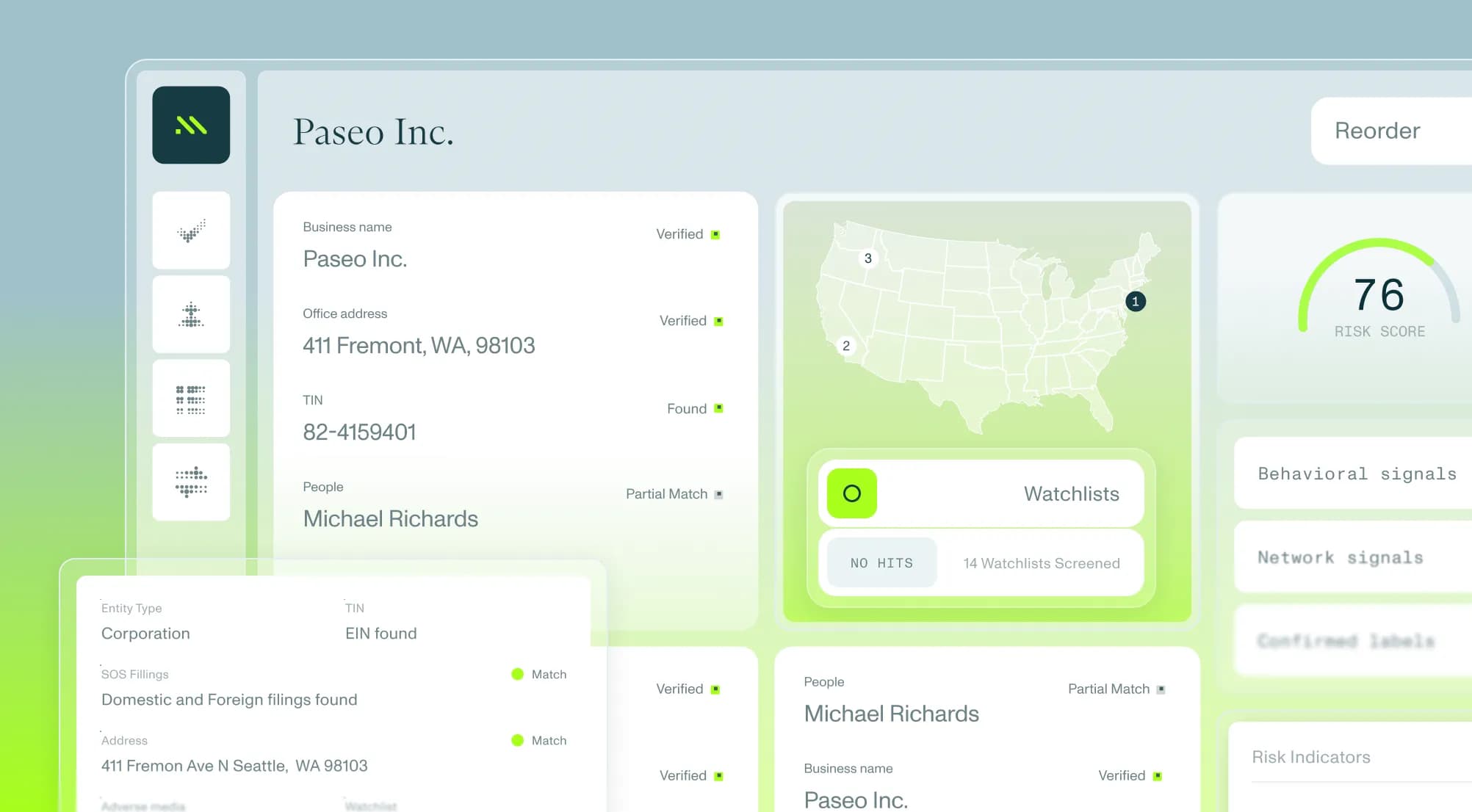
Business identity verification works best when data, intelligence, and workflow operate as one system. Fragmented KYB stacks force teams to reconcile conflicting business records, move decisions across tools, and rely on analysts to connect signals manually. A unified business identity platform gives compliance, risk, and product teams one business profile, one decision workflow, and a feedback loop that improves over time.
Three approaches to business identity verification
Most companies build their KYB programs in one of three ways: they rely on traditional data providers, assemble a stack of point solutions, or they use Middesk, the platform that connects data, intelligence, and workflow. The difference is not just vendor count. It is whether the system can turn business signals into consistent decisions.
The first path relies on traditional aggregators like LexisNexis and Dun & Bradstreet. Their pitch has been simple for the past half century: buy all the data, pay one vendor, make one decision. That model worked better when business formation, regulatory expectations, and fraud patterns changed more slowly. But the pace of business today is lightning fast, compliance standards have tightened and risk assessment is even more critical as fraudsters accelerate. One vendor's "complete picture" turns out to be incomplete and ineffective.
The second path is point solutions. Teams started using one vendor for each data point: registration, tax ID, ownership and fraud. It was a reasonable philosophy - buy the best point solution for every dataset and combine them later. This path led to overly complex systems requiring frequent human intervention and creating bottlenecks on speed and growth.
But a new way has emerged. An intelligence platform model with the best of both: exceptional data, network-level coverage, and specialized intelligence integrated inside.
Financial services companies that are winning right now took the third path and they’re running on Middesk. A platform built for business identity that delivers point-solution specificity without the fragmentation. Middesk is unpacking the complexity and helping companies get more clarity so they can move faster.
Why fragmented KYB stacks fail
Businesses are inherently complex. They can have multiple owners, layered legal structures, licenses across jurisdictions and officers that turn over. They move fast — companies get acquired, restructured, dissolved, and reformed. Each of these is a data point that needs to be captured, verified, and explained.
Most compliance teams want to know if they can work with a company legally and on what terms they should work with them. Companies using many data point solutions still struggle to answer those questions with confidence, let alone quickly. They end up with too much data, spread across too many systems that will ultimately need an analyst that can stitch it together. Fragmentation doesn't just create a data problem — it creates a headcount dependency that doesn't scale.
What a unified business identity platform actually enables
We started by building the best point solution for business identity data. Our customers in the financial services industry have taught us their needs go far beyond the verification of a data point.
Decisions can only be made at scale when you trust the data you have. Middesk developed the business identity intelligence layer that 700+ customers rely on for coverage, freshness, accuracy, and scale.
The most recent evolution of the Middesk platform adds orchestration and specialist agents grounded in Middesk’s business identity expertise. When something is flagged, agents are automatically triggered to research the issue, resolve what they can, and return their findings. When something gets flagged, the agents are automatically triggered to conduct research, resolve and return information on what they found. This reduces the time spent on manual review and empowers human analysts to focus on the most complex cases.
Intelligence only emerges at scale with a network effect. Something shifted when we reached 100% coverage of U.S. businesses. A mailing address could now be evaluated against every registered business—surfacing registered agent addresses and risk patterns. A business looks clean in isolation but patterns emerge once that business is mapped alongside other contextual information, such as adverse media, websites, people risk, business timelines and velocity changes.
The result is a platform where business identity data, risk signals, investigations, and decision workflows reinforce each other instead of living in separate systems..
Why scale matters
Middesk verifies millions of businesses annually, including a significant share of newly formed U.S. businesses. We see the whole network: thousands of businesses verified daily at formation. Our models are trained on outcomes, and work with risk scores that predict behavior. Each new verification makes the system smarter.
The move is simple
The compliance and product teams winning right now aren't the ones with the most data vendors. They're the ones where data, intelligence, and workflow are engineered as one system. Where each layer feeds the next and the system gets smarter with every business it processes.
That's what Middesk is built for. One platform, one business profile, data to decision without the handoffs or gaps that define the fragmented alternative.