Overview
The best artificial intelligence-powered Know Your Business platforms for banks and fintechs depend on whether your onboarding workflow prioritizes direct government registry verification, unified owner identity journeys, or multi-provider compliance orchestration. Know Your Business processes require confirming corporate legal existence, verifying beneficial owners and controlling individuals, and screening business entities against global sanctions and watchlists. Selecting a platform requires evaluating data source authority, beneficial ownership extraction, ongoing monitoring capabilities, and audit-ready review controls.
This guide explains how to evaluate AI-powered KYB tools, using Middesk as a product example rather than ranking vendors. Assess the business verification work a tool performs, the evidence it returns, and how it fits your institution’s onboarding and oversight requirements.
In brief
- Know Your Business platforms can automate business identity checks. Ownership research and ongoing screening depend on the platform and the checks enabled.
- Middesk connects directly to official state registries and uses autonomous agents to research data anomalies with auditable evidence.
- Test how a tool handles difficult applications and presents its findings to reviewers before deploying it.
Examine core capabilities in an enterprise KYB platform
Evaluating commercial onboarding platforms requires assessing four essential functional areas rather than focusing solely on automated match rates:
- Authoritative corporate data access: The platform should query official government registries, such as Secretaries of State and tax authorities, rather than relying exclusively on stale third-party data aggregators.
- Beneficial ownership identification: Compliance workflows must identify ultimate beneficial owners holding significant equity or managerial control, collect necessary identity disclosures, and initiate identity verification for those natural persons.
- Sanctions screening and lifecycle monitoring: Evaluate whether the platform supports the institution’s applicable sanctions obligations and risk-based screening procedures. U.S. CDD rules do not impose a blanket requirement to screen every business, officer, and owner against PEP lists and adverse media or to generate automated alerts for every status change.
- Defensible review records and oversight: A bank’s Customer Identification Program must retain specified identifying information, descriptions of documents relied on, the methods and results of non-documentary checks, and how substantive discrepancies were resolved. The rule does not require a timestamped confidence score for every clearance or escalation.
How Middesk supports AI-powered KYB
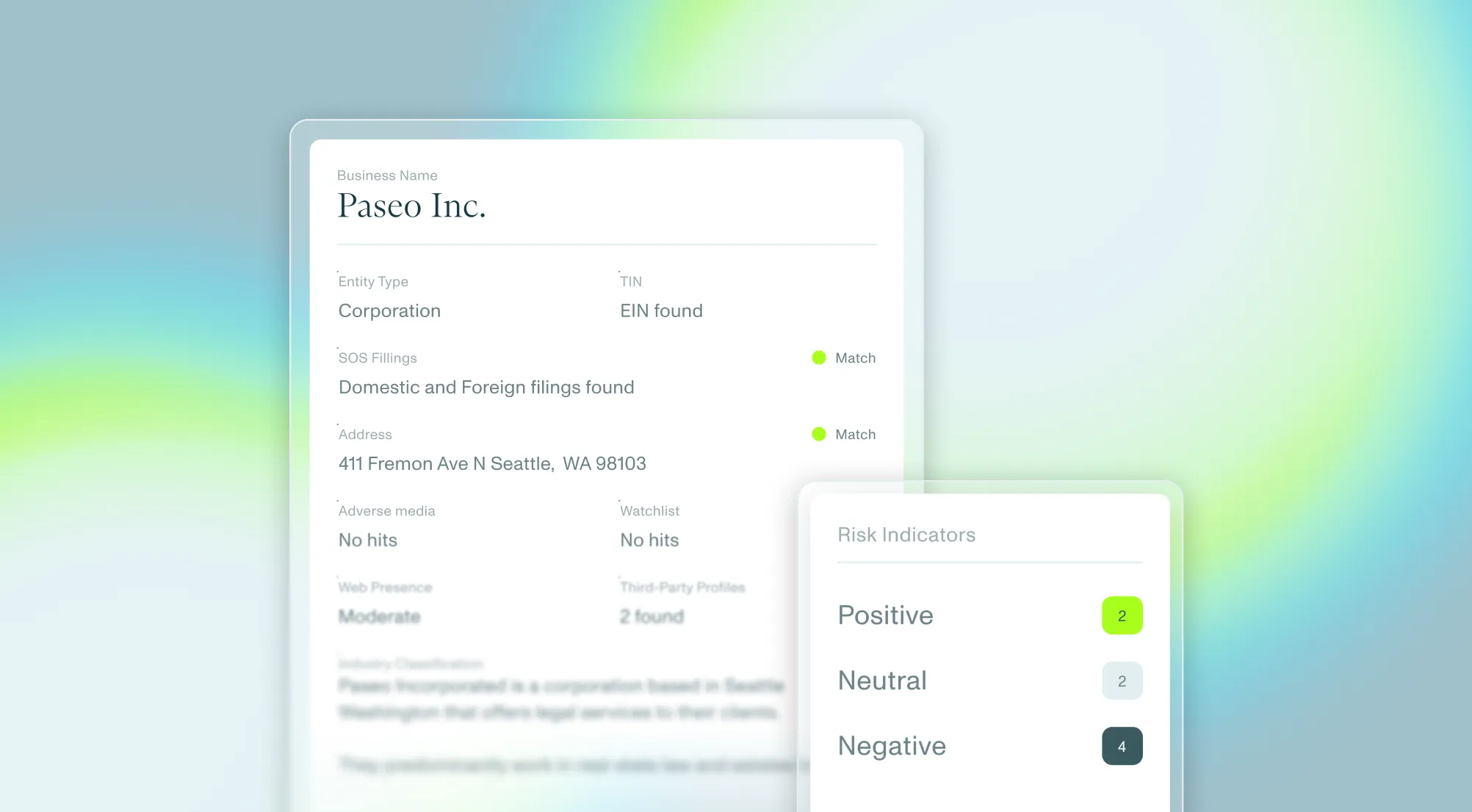
Middesk provides an infrastructure platform for commercial onboarding by connecting directly to official government registries across all 50 states and the District of Columbia. It automates business verification by validating corporate standing, checking legal names against federal tax records, identifying registered agents, and extracting recorded company officers.
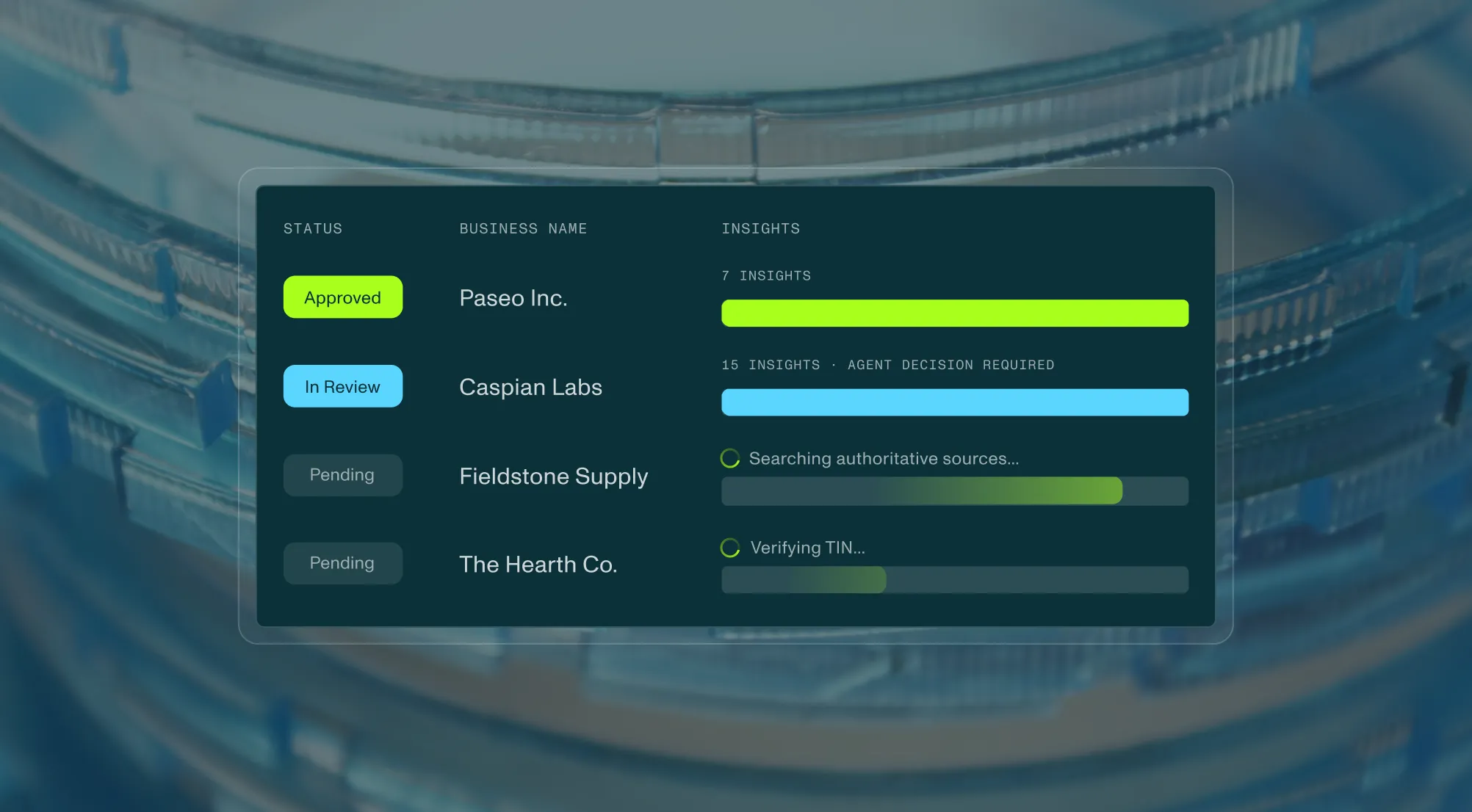
To maintain compliance with beneficial ownership requirements, Middesk automatically researches associated owners, officers, and members when an account creates a business profile. When verification uncovers ambiguous records, such as conflicting entity types or trade name variations, Middesk Agents execute structured investigation runs. These agents research public and official sources and generate structured artifacts containing confidence scores and source citations. As documented in Middesk's integration guides, runs pause for analyst review by default, allowing compliance officers to inspect evidence before approving accounts while supporting automated clearance for clean applications under configurable policy rules. For lifecycle management, Middesk Monitoring delivers automated webhook alerts whenever a subscribed business undergoes changes in state charter status, registered officers, physical addresses, or legal filings.
Select a KYB platform for banking and fintech deployments
Institutions planning an evaluation should test candidate platforms using difficult historical applications rather than clean demo accounts:
- Source provenance and transparency: Verify whether the platform retrieves data directly from primary registries or relies on cached secondary brokers. Request sample output showing how the platform documents data freshness and retrieval dates.
- Multi-tiered ownership resolution: Measure how effectively each platform extracts and displays complex ownership hierarchies, especially when ownership spans holding companies or trusts.
- Investigator workspace and evidence delivery: Evaluate the reviewer interface. Compliance analysts need structured evidence packages with primary source references rather than opaque pass or fail badges.
- System integration and workflow controls: Assess whether the platform provides robust webhooks and granular interrupt controls that pause high-risk applications for manual review while preserving automated processing for standard accounts.
Frequently asked questions
How do agentic KYB tools differ from traditional rule-based verification engines?
Rule-based verification engines rely on static logic, such as testing whether a submitted business name exactly matches a state registry entry. Agentic tools can formulate dynamic research plans, search alternative public filings like assumed-name registries to resolve discrepancies, and return structured findings supported by source citations.
Can an automated KYB platform satisfy bank regulatory expectations?
An automated platform helps gather required data, verify records, and document investigative steps, but software alone does not satisfy regulatory expectations. Federal supervisory frameworks hold the financial institution responsible for maintaining documented Customer Due Diligence procedures, verifying beneficial owners, and ensuring qualified human compliance professionals oversee risk-based exceptions.
What is the role of ongoing monitoring in a modern KYB program?
Ongoing monitoring tracks corporate changes after initial onboarding, including changes in Secretary of State charter status, registered agents, business addresses, officers, and watchlist designations. Continuous monitoring ensures that commercial accounts remain compliant throughout their operational lifecycle rather than relying solely on a point-in-time snapshot.

New to Middesk?
Talk to our team to see what business identity intelligence looks like inside your workflow.
Get a demo