Overview
The best artificial intelligence tools for detecting business identity fraud depend on whether your primary risk comes from corporate record manipulation, synthetic signers, or deceptive digital perimeters. Commercial identity fraud differs from consumer account takeover. Attackers establish synthetic legal entities, alter recorded officer details at state registries, and orchestrate credit bust-out schemes using fabricated operating histories. No single software tool covers every vector of commercial deception.
This guide focuses on Middesk and its partner Sardine, rather than ranking the entire market. Compare the business records each tool checks, the fraud signals it evaluates, and the evidence it gives reviewers. Test those capabilities against the types of fraud your team needs to investigate.
In brief
- Business identity fraud can involve impersonating an existing business, misusing its identifying information, or falsely claiming authority to act for it.
- Test each tool against confirmed fraud cases and legitimate applications before choosing it.
- Sardine evaluates perimeter device signals, behavioral biometrics, and cross-platform consortium fraud indicators.
- Middesk validates corporate records directly against state registries and uses autonomous agents to investigate verification discrepancies with source-backed evidence.
Understand the core signals of commercial identity fraud
Commercial fraud targets vulnerabilities across three distinct operational layers: legal entity legitimacy, authorized representative authority, and digital application behavior. Trade payment history can help assess credit risk, but it does not establish that the applicant is authorized to act for the business. These sources often leave blind spots during early onboarding, especially when fraudsters manipulate newly registered corporate charters or present altered formation documents.
Detecting commercial fraud requires automated evaluation of several key signal categories:
- Corporate registry standing: Check the business’s registration status and filing dates in the relevant state registry. The filings show what was recorded, not how long the business has been operating.
- Tax identifier pairing: Direct confirmation that the business name and Employer Identification Number align with official government tax records.
- Digital perimeter telemetry: Inspection of hardware signatures, virtual private network usage, and location anomalies that suggest automated script attacks or multi-application fraud rings.
- Document integrity indicators: Digital forensics that detect mismatched fonts, altered pixel layers, and tampered financial or formation filings.
- Relational network patterns: Graph linkages connecting seemingly unrelated business applications through shared physical addresses, phone numbers, bank accounts, or signers.
Compare Middesk and its fraud-platform partner
Middesk lists Sardine in its partner directory. Evaluate the business verification and fraud checks each product performs, and confirm which capabilities are included in the integration.
Sardine: behavioral telemetry and consortium risk signals
Sardine focuses on detecting commercial fraud at the perimeter and during payment execution. Rather than treating onboarding as an isolated event, Sardine evaluates applicant interaction behavior, device telemetry, and cross-industry consortium data in real time.
Its detection engine identifies high-risk technical signals, such as proxy masking, device emulators, and automated form-filling scripts. Sardine pairs perimeter intelligence with an AI rule builder that allows fraud teams to model risk typologies using behavioral attributes. For U.S. business verification, Sardine partners with Middesk on state registration checks, business name and tax ID matching, and business sanctions screening. When suspicious patterns emerge, the platform can trigger automated step-up reviews or route the application to fraud analysts.
Middesk: authoritative registry validation and agentic investigation
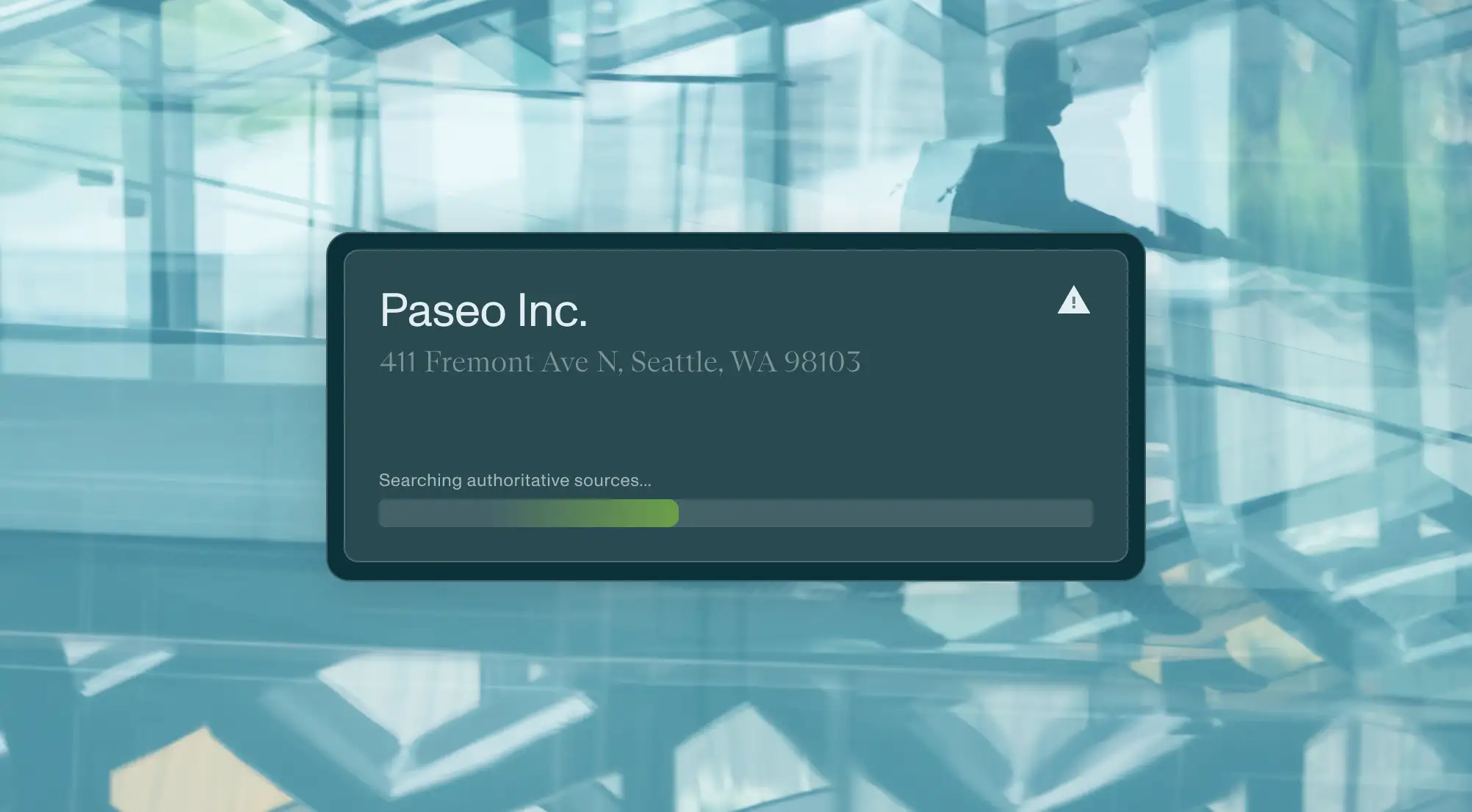
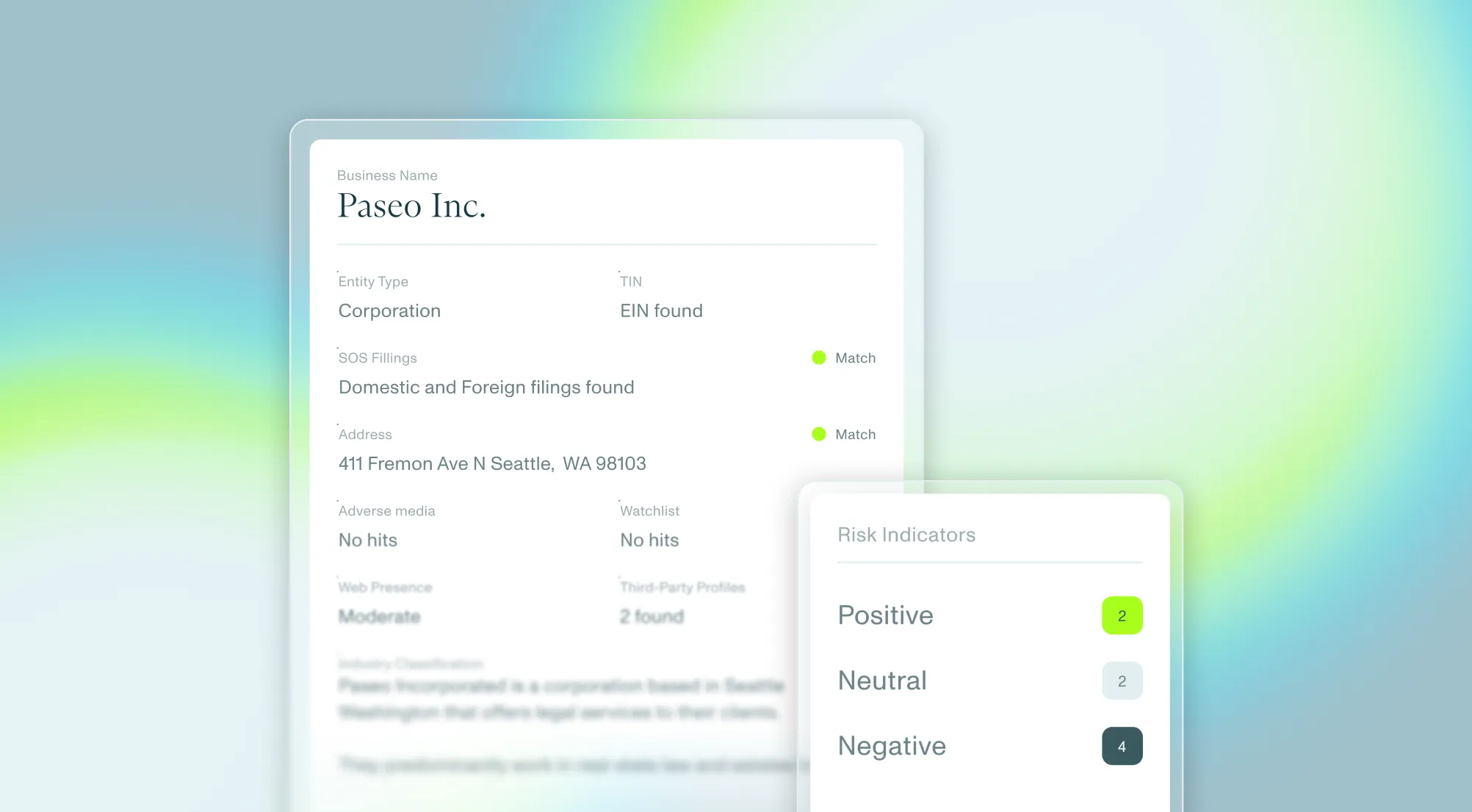
Middesk focuses on foundational business identity verification by connecting directly to official government registries across all 50 states and the District of Columbia. It checks business registration status, matches the submitted business name and Employer Identification Number against IRS records, and returns registered-agent and officer details when available.
When verification surfaces ambiguous signals, such as mismatched trade names or altered corporate records, Middesk deploys autonomous AI agents to investigate the findings. As detailed in the Middesk Agents documentation, these agents formulate research plans, gather records across government sources, and return structured artifacts. Every artifact includes confidence scoring and explicit source citations, creating an auditable evidence trail for compliance teams. Middesk allows institutions to configure interrupt policies, ensuring runs pause for human analyst review by default while allowing automatic approval for clear low-risk records under defined rules.
Evaluate commercial fraud detection tools
Selecting software requires testing candidate tools against real application data rather than relying on vendor demonstrations. Teams should run comparative evaluations across four primary criteria:
- Detection accuracy on synthetic filings: Test how effectively each tool uncovers synthetic businesses formed with valid tax IDs but fictitious owners, as well as dormant shell corporations reactivated for bust-out schemes.
- False positive rates on legitimate small businesses: Measure how often clean applicants, such as sole proprietorships or home-based enterprises, are incorrectly flagged due to shared virtual office addresses or missing web profiles.
- Evidence depth for investigators: Assess the transparency of the output. Investigators require primary document extracts, exact registry timestamps, and clear rationale rather than opaque, unexplainable risk scores.
- Human oversight controls: Ensure the software supports configurable escalation queues and review thresholds that align with your institution's risk appetite and regulatory audit requirements.
Frequently asked questions
What is the difference between consumer identity theft and business identity fraud?
Consumer identity theft typically involves stealing an individual's personal credentials to access credit lines or take over accounts. Business identity fraud involves creating synthetic business entities, hijacking legitimate corporate registration charters, or misrepresenting authorized signers to secure commercial credit lines, factor fraudulent invoices, or facilitate payment laundering.
Can an AI fraud detection tool eliminate manual reviews completely?
No. While automated rules and AI agents can resolve routine data mismatches and filter out obvious automated attacks, complex commercial structures and high-risk anomalies still require human judgment. Assign responsibility for final approval decisions under your organization’s policies and any requirements that apply to it.
How do graph analysis tools identify organized commercial fraud rings?
Graph analysis engines identify hidden relationships between separate business applications by evaluating shared data points. Where those data are available, link analysis can surface shared details across applications. Reviewers can investigate whether a link reflects coordination or has a legitimate explanation, such as businesses using the same registered agent.

New to Middesk?
Talk to our team to see what business identity intelligence looks like inside your workflow.
Get a demo