Overview
A corporate card underwriting policy should cover five areas: which businesses qualify, what financial information the issuer uses to assess repayment capacity, how it sets credit or spending limits, who is responsible for repayment, and how it monitors accounts after approval. The policy should also specify when payment is due and who can approve exceptions.
Charge cards generally require payment in full each billing cycle, while revolving credit cards allow businesses to carry a balance. That distinction matters when setting limits: the issuer needs to assess whether the business can pay on the schedule the card requires.
In brief
- Define which businesses qualify and what the issuer needs to verify.
- Specify how cash balances, revenue, or cash flow inform the initial limit and later adjustments.
- State who is liable for charges and whether an owner must sign a personal guarantee.
- Define which events prompt an account review and which can trigger an automatic limit change.
Five core components of a corporate card underwriting policy
A corporate card policy guides both the initial approval and later decisions about how much the business can spend. For each of these five areas, specify what evidence the issuer needs and what it does when that evidence is incomplete or changes.
- Legal entity eligibility and standing. Specify which business structures the program accepts, such as corporations or limited liability companies. Check state registration status where applicable, match the submitted business name and tax ID, and verify the operating address. Define which discrepancies need review before approval.
- Cash flow and liquidity requirements. Specify which financial records the issuer accepts and how far back they need to go. A cash-based program may use balances from connected accounts, with the applicant’s permission, or from bank statements. A program that evaluates revenue or cash flow may also review income statements or cash-flow statements. If the program requires a minimum cash balance, define which accounts count and whether the policy uses a current balance or an average over a set period.
- Setting spending or credit limits. Specify which financial measures determine the initial limit, how the repayment schedule affects it, and what caps apply. A cash-based program may adjust the limit as available balances change. A program that underwrites on revenue or cash flow can use updated financial statements to reassess the limit. Define who can approve an exception and when a temporary increase expires.
- Guarantees and liability. State who is responsible for card charges under the agreement and whether the program requires a separate personal guarantee from an owner. A guarantee makes the owner responsible for the business’s debt under the terms of that guarantee. It is distinct from an employee cardholder’s liability for charges on their card.
- Ongoing account monitoring. Define what prompts a review, such as a returned payment, a sustained drop in cash balances, or a new public filing. Specify when to request updated financials, reduce a limit, or suspend spending. State which actions can happen automatically and which require approval.
For example, a drop in cash during the low season may warrant a look at the prior year’s cash flow, while a returned payment may call for a more immediate review. A new Uniform Commercial Code (UCC) filing is a reason to check what changed, not an automatic reason to cut the limit. The policy should say who reviews each signal and what evidence they need before acting.
Mitigating bust-out fraud and sudden default risk
Corporate card programs face exposure to bust-out fraud: schemes where an entity obtains credit, builds nominal repayment history to secure higher limits, and then maxes out card balances with no intention of repaying.
Pair upfront underwriting with controls that govern how the card can be used, when payment is due, and when an account needs review:
- Merchant category controls. Specify which merchant category codes (MCCs) the program blocks or flags for review. These controls apply to where the card is used and are separate from the rules that determine which businesses qualify for the card.
- Repayment schedule. Define how often the company must pay its card balance. If the program offers more than one schedule, specify which businesses qualify for each.
- Public-record monitoring. Check for registration changes and newly detected filings, such as bankruptcies or UCC filings. Review what changed before deciding whether it affects the account.
How Middesk supports verification and monitoring
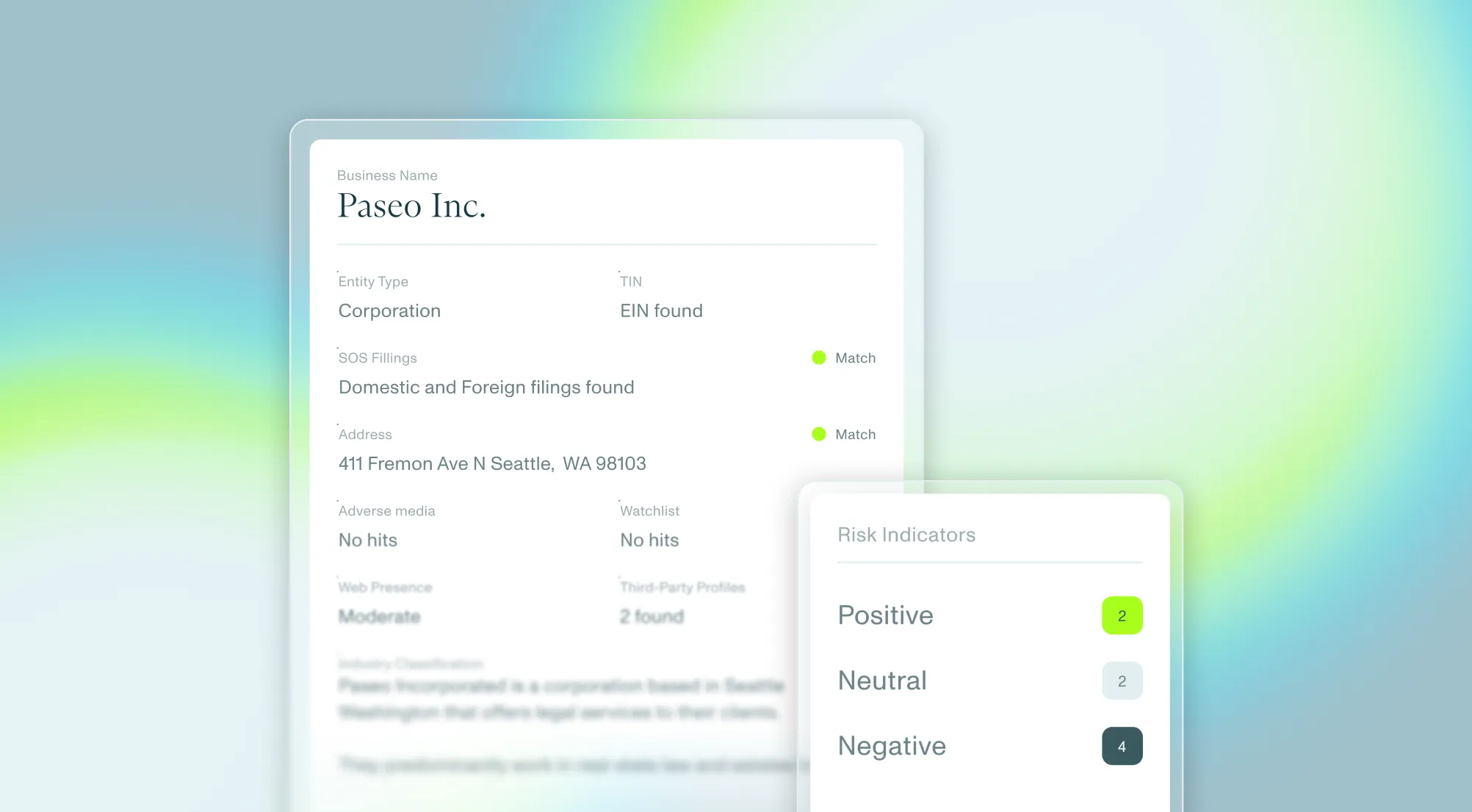
Middesk helps issuers check business registration status, match a submitted business name and tax ID against IRS records, and verify address information.
For businesses enrolled in the relevant monitoring services, Middesk can notify the issuer when it detects a registration change, a bankruptcy filing, or a new UCC filing. The issuer uses those findings alongside its financial and payment data to decide whether to request updated information or change the account limit.
Frequently asked questions
How do corporate card issuers underwrite startups with no credit history?
Depending on the program, issuers may review cash on hand, how quickly the startup is using that cash, and any documented funding. They can use those records to assess whether the business can meet the card’s repayment schedule and set an initial spending limit.
What is the difference between a corporate card and a small business credit card?
A small business credit card may rely on the owner’s credit and require a personal guarantee. A corporate card program generally evaluates the company and provides controls for employee spending. Depending on the card agreement, the company may be solely liable or may share liability with individual cardholders.
What can trigger a corporate card limit review?
A returned payment, a sustained decline in cash balances, or an adverse filing can prompt a limit review. A review does not necessarily mean a reduction. The issuer’s policy determines when a limit changes automatically and when an underwriter reviews the evidence first.
How do issuers handle businesses with seasonal cash flow?
Issuers can review cash flow across a full operating cycle, including the low season, to assess whether the business can meet its repayment schedule. If the issuer approves a temporary limit increase for a seasonal need, the policy should specify when the increase expires.

New to Middesk?
Talk to our team to see what business identity intelligence looks like inside your workflow.
Get a demo