
Overview
Banks have historically held back on new technologies, wary of supervisory frameworks built for older and more predictable systems. In April, FinCEN moved to change that, saying it encourages institutions to adopt tools like machine learning and generative AI, and that testing them should not by itself trigger added supervisory or enforcement risk.
The April proposal also says innovative tools, including AI, may help show that an AML/CFT program is working. Director Andrea Gacki said in July testimony that the proposed rule "refocuses AML/CFT programs on effectiveness, rather than mere technical compliance."
In brief:
- In its April AML program reform proposal, FinCEN said institutions should not face added supervisory or enforcement risk solely for responsibly testing innovative technology like machine learning and generative AI in their programs.
- The proposal refocuses AML programs on effectiveness over technical compliance — meaning AI can count when it produces better intelligence, better investigations, and better records.
- Public comments exposed a gap between permission and practice: banks and trade groups want support for AI to be durable enough to hold up in examinations, not just AI-friendly language.
The push for innovation in risk management
Since at least 2018, FinCEN and other regulators have encouraged banks to test new approaches, including AI, to detect and report suspicious activity. The pressure has increased as criminals use generative AI and deepfakes to create fake IDs, open accounts, and move fraud proceeds.
Treasury said in a March report to Congress that well-governed technology can be a "force multiplier" for AML/CFT and pointed to AI uses such as case reviews, suspicious activity investigations, SAR narrative drafting, among others. The report also named the limits: AI can be hard to explain, expensive to govern, and difficult for smaller institutions to adopt without clearer supervisory expectations.
In April, the Fed, FDIC, and OCC said generative AI and agentic AI are outside revised model-risk guidance because the technology is still novel and changing quickly. Banks need room to test AI without pretending it fits cleanly into rules written for a different kind of system.
How Middesk Agents make AI reviewable in AML investigations
AML teams know the limits of rules-based monitoring and how legacy systems generate large volumes of alerts. Analysts waste time clearing false positives, documenting decisions, and preparing for exams while criminals use automation and stay one step ahead.
Middesk Agents can speed up AML investigations in a way that analysts can review, making AI useful inside a regulated workflow. Agents gather evidence, check sources, explain their reasoning, and return structured findings inside the business report. The reviewer can accept, correct, or override the result.
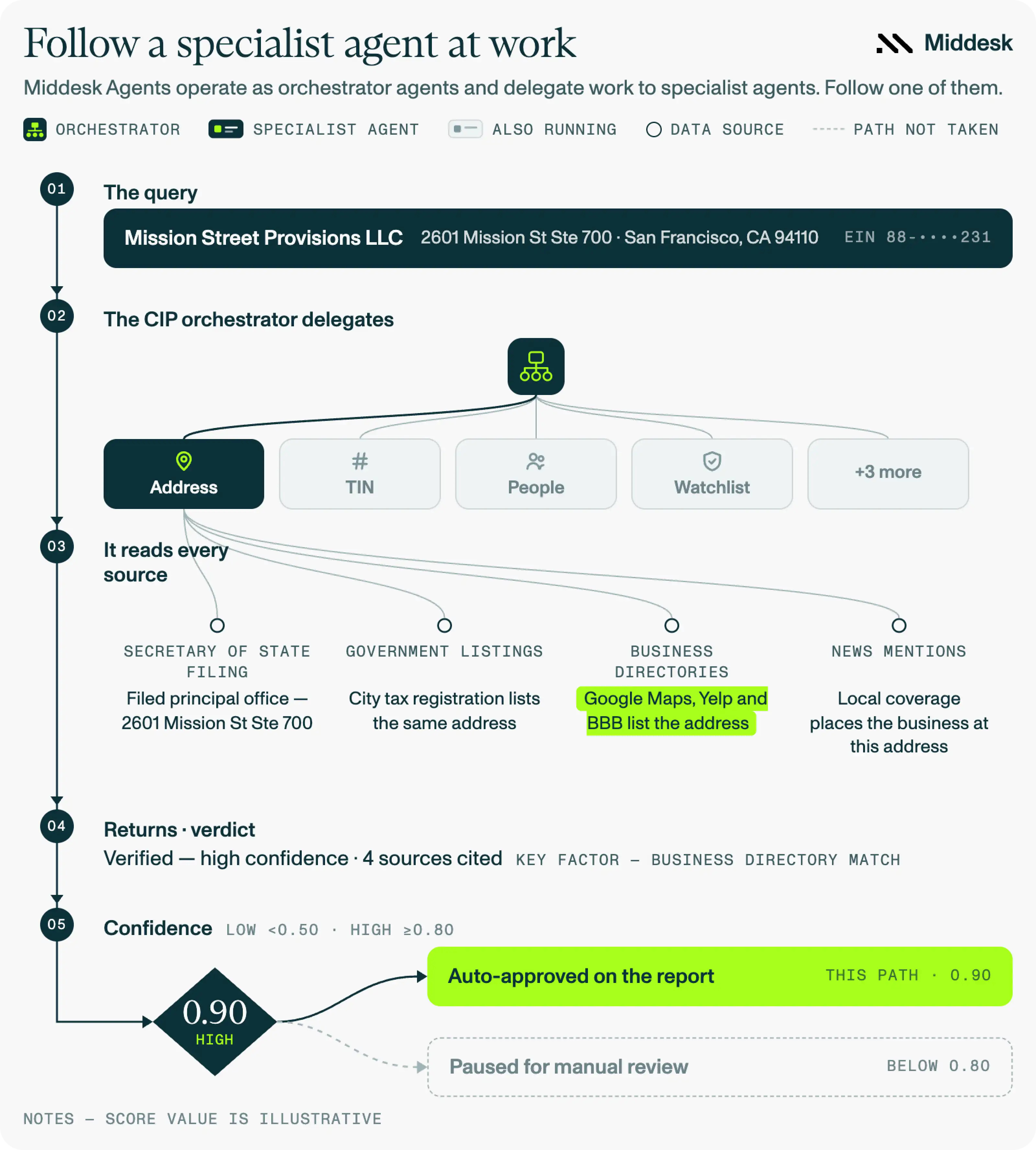
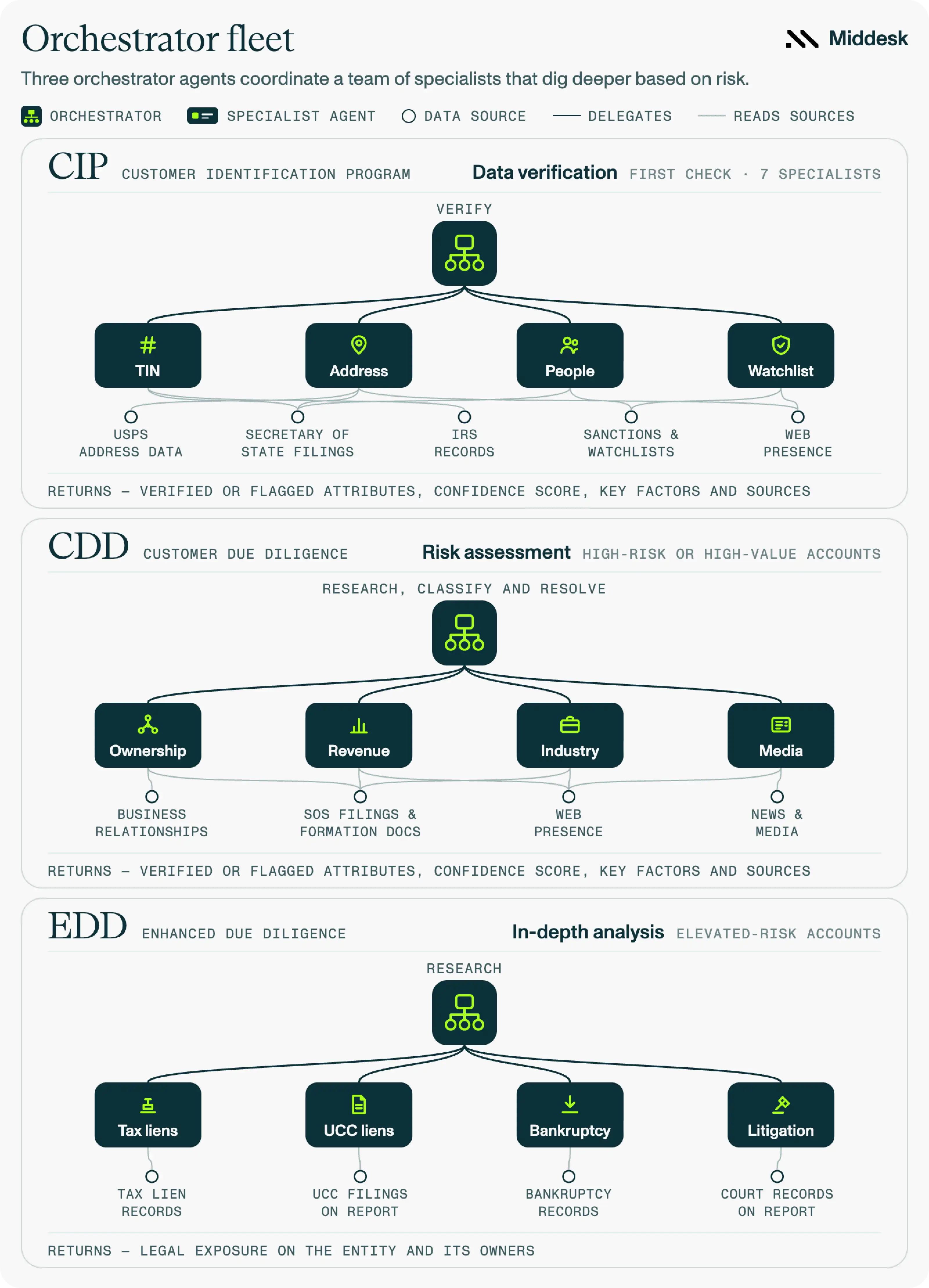
Each Middesk agent maps to one of the main stages of AML review: Customer Identification Program, Customer Due Diligence, and Enhanced Due Diligence. Some verify inputs against authoritative sources, some resolve ambiguous watchlist hits, and others classify risk or research legal and financial filings.
A bank uses Middesk Agents to review business applications that fail name, address, or watchlist checks. The team wants enough evidence for examiners to understand why a case was cleared, escalated, or sent for more information.
One customer has analysts spending hours gathering open-source material, checking counterparties, and writing review narratives. Another wants to reduce manual lien and litigation reviews, where analysts decide whether a filing is relevant and whether the business poses a real risk. They now use Middesk agents so they can move faster while getting a record that is easier to audit.

Move faster with Middesk Agents
Reduce manual review on false-positive alerts. See how compliance and risk teams use AI to gather evidence, explain findings, and keep decisions tied to a reviewable record.
Book a meetingWhat the industry said
Public comments on FinCEN’s April proposal focused on the gap between permission and practice. Banks and trade groups want support for AI to hold up when regulators review their AML programs. Tech companies want regulators to define what shows an AI tool improved an AML program. Smaller institutions want the final rule to prevent AI from becoming an unofficial requirement.
Big banks and trade groups, like the American Bankers Association and the Bank Policy Institute, asked regulators to make support for innovation durable enough to matter in examinations. They said AI-friendly language does little if examiner behavior does not change.
The comments were asking FinCEN to make innovation examinable. HSBC said the final rule should say that new technologies can be part of a reasonably designed AML program and that examiners should consider those tools when evaluating effectiveness. It also warned that banks will hesitate to reduce low-value alerts or shift resources toward higher-risk activity if examiner expectations still reward old monitoring volume over better results.
For banks, AI use will count towards gathering evidence that their AML program can detect risk, explain decisions, and stand up in review.