Overview
Fraud rings create fake businesses by combining real public records with fabricated information to pass automated bank onboarding checks. Criminals take advantage of disconnected government systems by filing real state corporate registrations, pairing them with unrelated or inactive federal tax IDs, and using commercial mail drops as business addresses.
State filing offices register companies when applicants meet the state’s filing requirements and pay the required fee, but they do not verify whether the company conducts real business or has physical operations. Automated onboarding systems that rely on basic checklist checks often mistake these artificial profiles for legitimate companies. Once opened, criminals use these business bank accounts to collect and move stolen funds from email compromise schemes, redirected invoices, and payment fraud.
In brief
- Criminals assemble fake business profiles by pairing real state entity registrations with unrelated federal tax identification numbers.
- State filing offices record business filings upon fee payment without verifying incorporator identities or confirming physical operating locations.
- Business bank accounts opened under synthetic identities give criminals high-limit payment channels to divert funds from invoice scams and wire fraud.
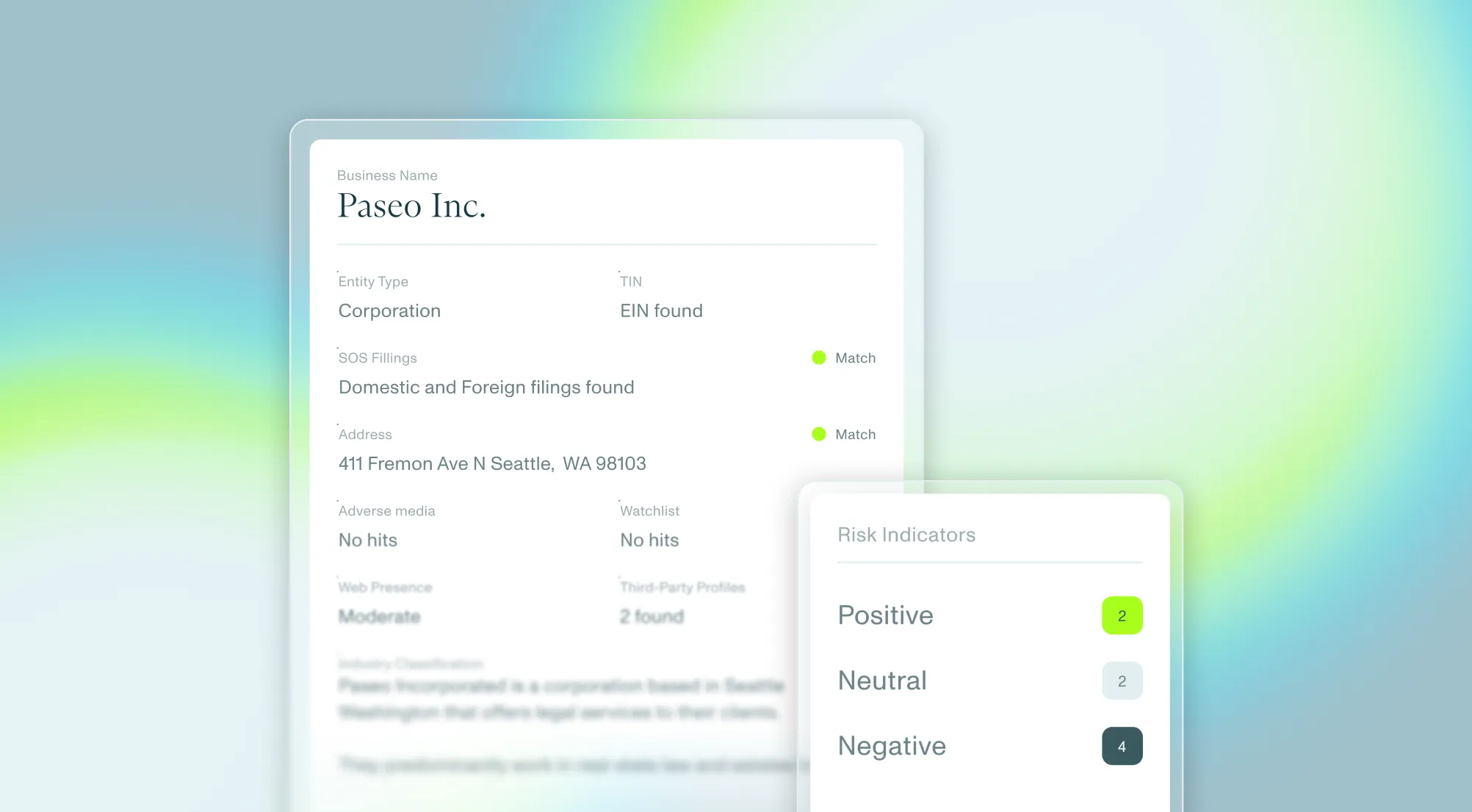
- Multi-source onboarding checks compare state registration records, IRS tax name matching, and postal delivery data to uncover mismatched business details.
The illusion of corporate legitimacy in automated onboarding
Commercial account opening workflows evaluate electronic data attributes against public records. Rather than presenting altered paper documents or counterfeit certificates of formation, fraud operators assemble composite profiles that satisfy automated checklist rules while concealing the absence of authentic commercial operations.
This vulnerability stems from the division of authority across public agencies. State corporate filing offices function as administrative recording bodies that issue corporate charters upon payment of statutory fees. They generally do not verify the identities of incorporators or confirm whether an enterprise conducts physical operations. Tax authorities issue Employer Identification Numbers (EINs), the federal nine-digit numbers assigned by the Internal Revenue Service for tax administration, through automated systems without requiring physical presence. As the Financial Crimes Enforcement Network (FinCEN) observed in its guidance on shell companies, entities with no physical presence or independent operations can be exploited to obscure beneficial ownership and transfer illicit proceeds.
Primary typologies used to assemble fake business profiles
Automated onboarding systems evaluate applicant information against public records to screen new accounts. Fraud rings assemble composite business identities using several coordinated techniques to clear initial automated screening filters:
- State Registry Shell Formation: Syndicates submit electronic articles of organization through state portals offering automated processing. Filers pay statutory fees using virtual cards and obtain authentic legal charters without identity verification of the incorporator.
- Synthetic Tax Composite Assembly: Operators pair an active corporate charter with an Employer Identification Number (EIN) belonging to a separate dissolved corporation or sole proprietorship. Intake filters performing EIN format checks alone fail to detect mismatches between the business name and federal tax records.
- Physical Footprint Concealment via Commercial Mail Drops: Applicants submit private mailbox numbers at a Commercial Mail Receiving Agency (CMRA), which is a business authorized to accept and handle mail on behalf of third parties, or a shared virtual office suite, often formatting the box as a corporate suite to simulate an operating plant.
- Straw Signers and Synthetic Beneficial Owners: Operators recruit straw signers, who are individuals paid to lend their identities to corporate filings, or combine demographic data attributes to clear individual Customer Identification Program (CIP) checks.
- Corporate Entity Hijacking: Filers monitor state registries for entities in administrative forfeiture or inactive status due to delinquent annual reports, then file unauthorized amendments updating registered agents and officers to misrepresent an established operating history.
Operational routing and multi-layered verification controls
Business bank accounts opened under synthetic identities give fraud rings payment channels for moving stolen funds. Fraud rings target business accounts because commercial payment channels offer higher transfer limits, larger transaction velocity, and routine third-party disbursements that would trigger immediate scrutiny on personal consumer accounts.
Once an account is approved, operators route funds diverted through business email compromise (BEC), unauthorized invoice redirects, or merchant card schemes through the depository facility. Proceeds are rapidly disbursed through domestic wire transfers, international wires, or digital asset conversions, exposing financial institutions to chargeback liabilities, indemnification claims, and uncollectible negative balances once the diversion is uncovered.
Mitigating synthetic onboarding requires replacing disconnected data lookups with multi-source cross-verification. Confirming an active charter or a structurally valid tax identifier does not confirm authentic commercial activity or signer authorization. Depository institutions can query primary state corporate registries to inspect organizational standing, formation dates, and recent governance amendment histories.
Eligible payers and their authorized agents can use the IRS Taxpayer Identification Number (TIN) Matching Program to check payee names and TINs for information reporting, though TIN matching only confirms the legal name-to-number pairing rather than the applicant's authority to transact. In addition, checking addresses against USPS Delivery Point Validation (DPV) identifies commercial mail drops and private mailboxes. DPV confirms postal deliverability and mail-drop classifications rather than physical operational activity. Detecting complex synthetic profiles requires evaluating these technical signals together during onboarding.
Frequently asked questions
How do fraudsters obtain authentic state corporate charters for fake businesses?
Fraud operators submit electronic articles of organization through state Secretary of State filing portals, paying statutory fees with prepaid or virtual cards. State filing offices operate as administrative recording agencies rather than investigative bodies, so they issue charters upon payment without verifying applicant identity or operational legitimacy.
Why doesn't an IRS TIN match prove an applicant is authorized to open an account?
The IRS TIN Matching Program only confirms that the submitted Employer Identification Number matches the legal business name in federal tax records. It does not verify the identity of the person submitting the application, confirm physical operations, or establish signer authorization to bind the business.
What is the operational difference between a CMRA mail drop and a legitimate corporate address?
A Commercial Mail Receiving Agency (CMRA) is a private business authorized by the postal service to accept and forward mail for third parties, often renting numbered private mailboxes designated by ‘PMB’ or ‘#’. Legitimate operating companies conduct real business activity at their physical locations. Postal delivery point codes verify a delivery point, not whether the business operates there.
What primary payment fraud schemes rely on synthetic business bank accounts?
Synthetic business bank accounts primarily serve as channels to collect and move proceeds from business email compromise (BEC), unauthorized invoice redirection, and merchant payment fraud. Fraudsters exploit higher commercial transfer limits and transaction speed to disburse stolen funds before victims discover the theft.

New to Middesk?
Talk to our team to see what business identity intelligence looks like inside your workflow.
Get a demo