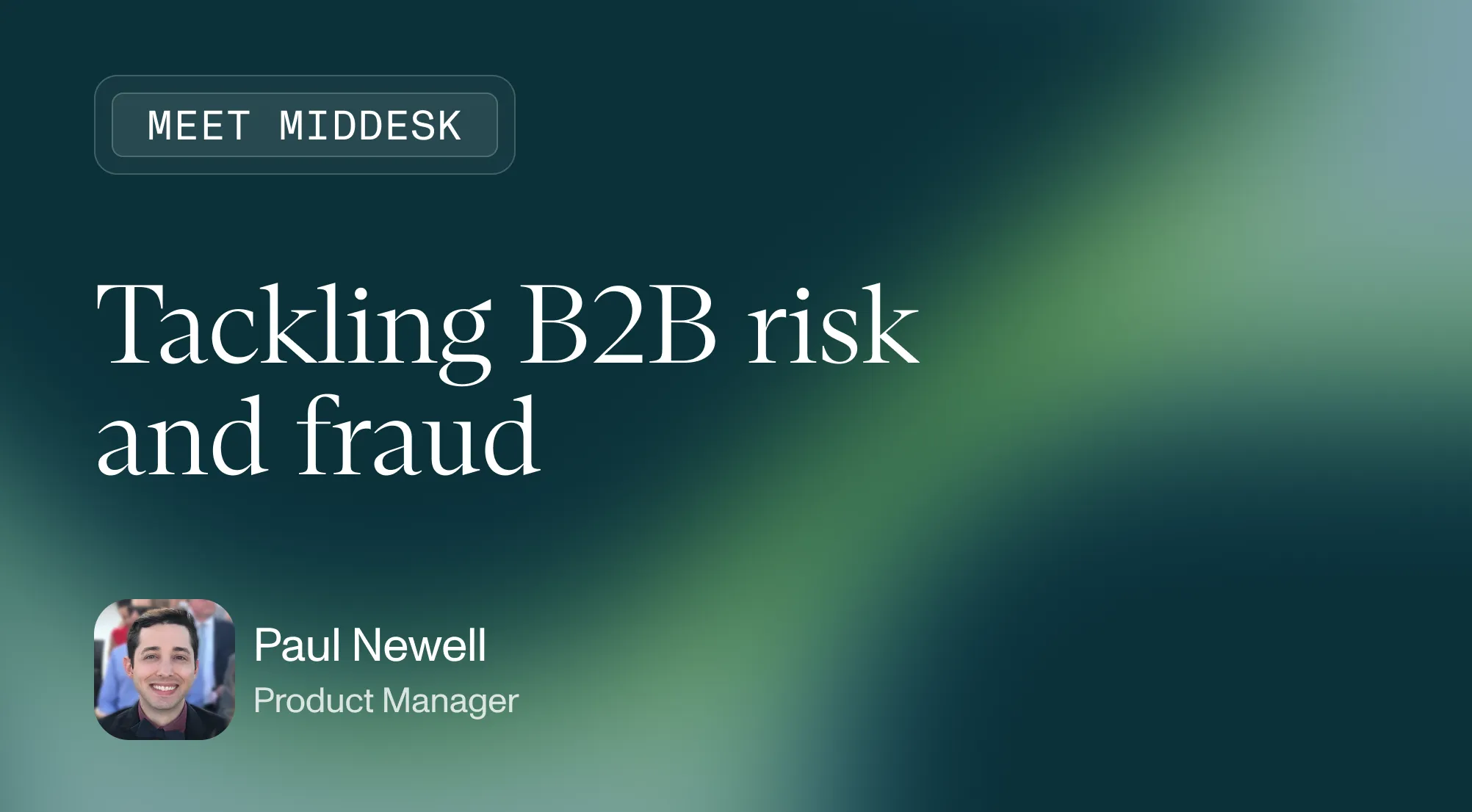

Meet Paul
Paul Newell is a Senior Product Manager at Middesk, where they lead the company's fraud and risk products. They came here specifically to take on a problem that has stumped the industry for years: first-party B2B fraud.
Before Middesk, Paul spent four and a half years as Unqork’s first Product Manager, joining during a hyper growth phase when the team grew from a handful of people to over 600. There, they built a deep instinct for zero-to-one product work. Then Paul moved to Signifyd, where they owned a core e-commerce fraud detection product and got close to the machine learning side of fraud.
What connects all of their work is a bias toward impact and a talent for seeing angles others miss. In this conversation, they talk about what drew them to Middesk's hardest challenge, how AI is reshaping what fraud looks like, and why the product foundation being laid right now is what makes everything ahead possible.
Joining Middesk
At Signifyd I owned a well-established fraud detection product. Interesting work, but it was not zero-to-one. First-party B2B fraud is largely unsolved, not because people have not tried, but because it is genuinely hard. I wanted to take what I had learned there and bring it somewhere I could do something new with it. Middesk felt like the right place.
And then there were the people. I have had the experience of interviewing somewhere, feeling culturally aligned, and then joining to find it was quite different. None of that happened here. The interview process was transparent, and when I joined, working here felt almost exactly like what I had expected. Across leadership and every team I have worked with, I keep having the same experience: I finally sit down with someone new and think, they are just so great. Bright, kind, and low ego in a way that I think is genuinely rare.
Why trust is getting harder
Why is trust such an urgent problem for businesses right now?
We were always heading this way. As more of life moved online, establishing and maintaining trust became a slowly growing problem. Then the pandemic and AI turned it into a rocket ship.
The pandemic pushed most services online that had never been online and removed the friction that used to make establishing trust more measured. Almost overnight, a huge amount of surface area for potential fraud opened up that had never been pressure tested. Then AI dropped the barrier even further. Spinning up a convincing fake business or identity is far easier than it used to be, and it happened so fast many systems could not catch up. That combination is what made trust so urgent.
Changes in the B2B fraud landscape
What has changed most in the last few years?
The barrier to entry for bad actors has lowered dramatically because of AI, and that means the patterns we have to look for have changed just as much.
Take transaction laundering. A fraudster spins up an e-commerce site, takes payments, delivers nothing or something misrepresented, pulls the money out, shuts it down, and repeats under a new identity. We used to catch them by looking for overlapping content, because they reuse a lot of the same material. That still works. But with AI, spinning up entirely new platforms with convincing fake content is cheap and fast. So detection has to get a lot more sophisticated.
Fraud has always been a cat and mouse game. What is unprecedented now is how fast the fraudster's toolkit changed. That is almost entirely because of AI. Middesk has always cared about providing accurate data and intelligence about businesses, so we are deeply invested in staying ahead of this curve.
Building Business Risk Intelligence
What problem are you solving for customers with Merchant Risk?
Merchant Risk is the first use case in a broader Business Risk Intelligence suite we are building. It focuses on commerce and breaks down into three areas:
- Reputational risk - how a merchant could damage your brand or create compliance exposure
- Connection risk - how a business ties back to known fraud networks
- Operational risk - how the business actually runs, for example risky refund policies, prohibited goods, industry misrepresentation. The classic example is a merchant who says they run a bakery but is actually selling something else entirely.
What makes this hard is that every vertical has its own fraud types, and each one comes with a different kind of actor and a different set of behaviors to catch. Change the vertical and the target changes completely. What makes this hard is that everything changes from one business vertical to the next: the vertical itself, the fraud types most common within it, and as a result the way the bad actor looks and behaves. A one-size-fits-all model has never worked to detect fraud, which is a big reason this problem has not really been solved. So at Middesk, we are going vertical by vertical, going deep on the signals that separate good actors from bad ones, and expanding from there. E-commerce is where we’ve started.
AI and the future of business identity decisions
How is AI changing the way businesses make trust and risk decisions?
At Middesk, AI has had a huge impact on our back end processes and front end products. For example, fraudsters using AI are more challenging to catch, forcing us to build even more robust identities and data sources for businesses in order to catch them effectively. But AI also gives our back end data platform team even more capabilities to go and effectively do that. On the customer-facing product side, Middesk now has agents that enhance how much and how deep our investigations go which is a huge win for our clients.
What I am most excited about is what agents unlock for our identity graph. We have built a graph that maps connections between businesses and people across authoritative and web data. It is an incredibly powerful asset, but today it takes a person many hours to investigate through it. Agents change that. There are genuinely powerful ways we could let an agent surface scammer networks, shell company connections, and repeat offenders across that entire web of entities. A lot of fraud today is repeat actors creating new identities and starting the cycle again. This is exactly the tool needed to catch them. Pairing that level of automated investigation with what we have already built feels like it could finally solve B2B first-party fraud in a way it never really has been.
Building at Middesk
What makes building products at Middesk different?
Middesk is a high-autonomy environment. People here are willing to hand you the reins and trust you to make real decisions. It is not a micromanaging culture, and there is no hesitation about letting you step up.
At a lot of companies, politics and process get in the way. If I have done my research and put in the work, I know people will hear me out, give me the opportunity, and collaborate with me. It is a low-ego environment, and you get out of it what you are willing to put in. That autonomy also means every yes is a no to something else. If you know where you are headed long term, you can be deliberate about where you invest and where you do not. That clarity is one of the most useful tools I have as a PM, and Middesk is a place where you are actually empowered to use it.
Middesk values
Which Middesk value resonates most with you?
Putting customers first, without question. I got my start as a support engineer and have always been good at translating technical concepts into something people can actually understand. That instinct carried straight into how I show up as a PM.
For me it comes back to genuine empathy: understanding the problems customers are living with deeply enough to define them clearly, and then working through solutions from that place. Middesk holds this as a real value, not just a stated one. We have a deep empathy for our customers, and that shapes not just individual deals but what the North Star even needs to be. If you are not solving the right problems, and the only way to know is to truly understand them, not much else matters.
Curiosity
What keeps you curious outside of work?
I am an investigator at heart. When I pick up a new interest I go deep on it, and as I have gotten older I have started turning what I learn into something I can actually use. Learning enough about electrical work to change an outlet. Learning enough plumbing to automate the refill on my humidifier. At one point I got into cosmetics and learned how to make them, and there are still a few things I make myself.
The other piece is understanding other people. My favorite kind of story is one that lets me sit in someone else's shoes as closely as possible. Art that gives you a genuine window into someone else's experience opens up how you see the world and how you show empathy for people whose lives look very different from yours. That feels more important than ever.
Advice for product candidates
What would you tell a PM thinking about joining Middesk?
Middesk is a great fit if you like to go deep, understand customers and their problems, and define those problems well. That sounds obvious, but product roles look very different from company to company. Some are closer to project management. Some are heavily go-to-market. Here, it is about being the expert on customer problems and owning the solutions that drive real impact.
You are genuinely empowered to do that at Middesk. The people who thrive are self-driven, problem-focused, and excited to figure things out in an environment where the playbook is still being written. If that describes how you think about the work, this is the place.