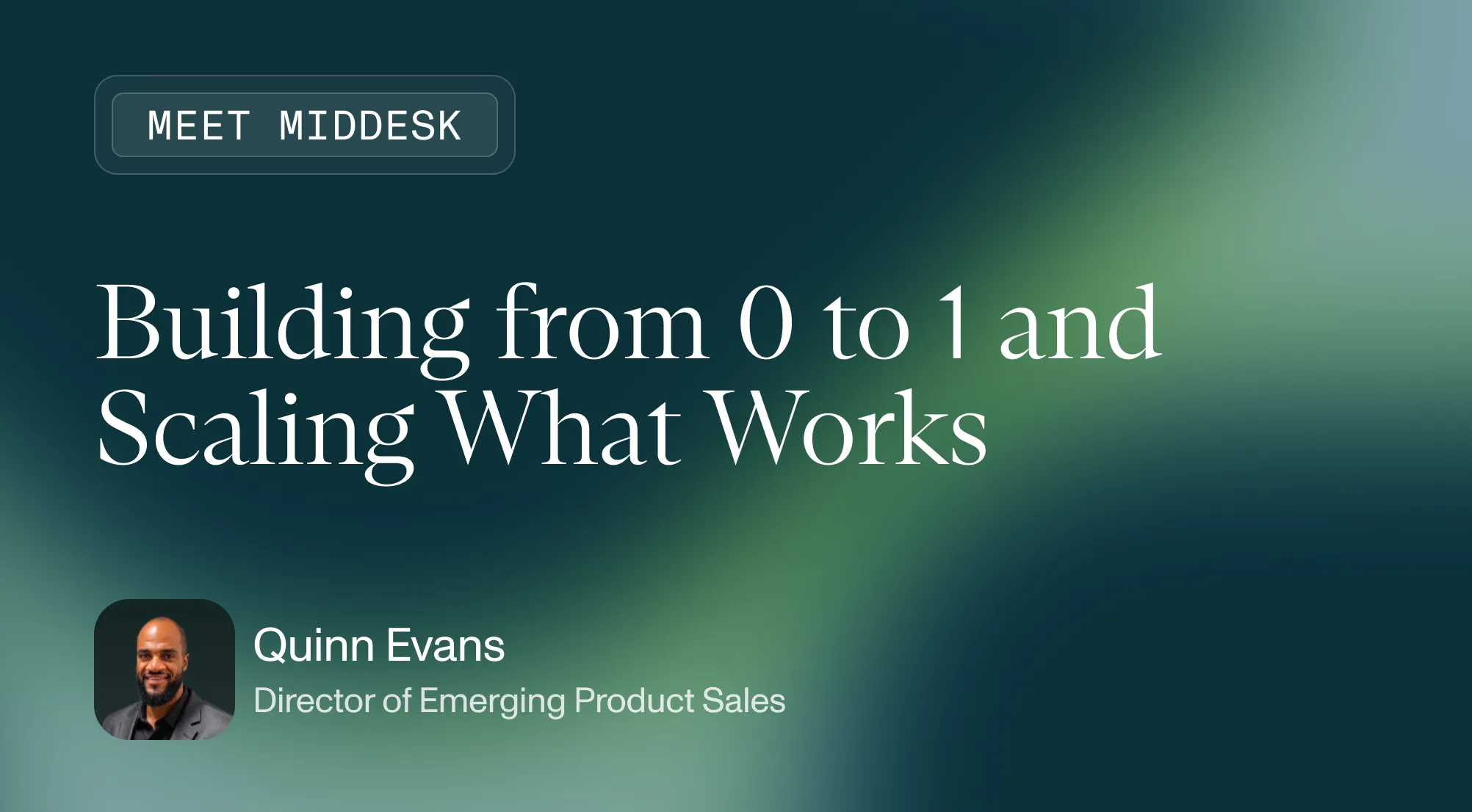

Meet Quinn
Quinn Evans leads our Emerging Products team at Middesk, partnering closely with Product and Engineering to take new ideas from hypothesis to revenue. Some of those products are still incubating. Others, like Entity Management, have grown well beyond their infancy and now represent a meaningful and expanding part of Middesk’s business.
Before Middesk, Quinn spent six years at Checkr across SDR, AE, and sales leadership roles. His path from frontline seller to leader shapes how he approaches growth today: with grit, accountability, and a deep belief that development and repetition compound over time.
Joining Middesk
How did your path lead you to Middesk?
I’ve never been afraid to go back to the reps. Earlier in my career, I stepped into an SDR role intentionally. I had sold before, but I wanted to slow myself down and really go through it, building email templates, cold calling, going to conferences where people are trying to avoid you and figuring out how to grab their attention anyway. You learn quickly what works and what doesn’t, and then you iterate off that and go again.
At Checkr, I worked alongside [Middesk cofounders] Kyle and Kurt. Not directly, but close enough that I knew who they were and they knew who I was, and I took it as a challenge to prove myself. I moved from SDR to AE, became a top performer, and eventually stepped into leadership. When an opportunity at Middesk came along, it felt full circle.
The same people I respected early in my career were building again, and the opportunity to help build something from the ground up, not just participate in it, was something I was excited to take on.
Emerging Products
What does Emerging Products mean at Middesk?
Emerging Products is our incubator, and I’ve joked before that we operate a bit like Seal Team 6. It’s a small group, very focused, very accountable, and everyone knows the mission. We’re not a big layered organization. It’s engineers, Product, and GTM working shoulder to shoulder and obsessing over a specific problem.
When you’re building something new, you don’t get it perfect the first time. It’s V1, then V2, then V3. You form a hypothesis, take it to market, learn from what breaks, and adjust. That scientific mindset: test, learn, refine is core to how we operate. At the same time, you can’t boil the ocean. You anchor on one real problem and solve it deeply.
And when something clicks, you double down.
The Entity Management product is a good example of that. What started as an emerging product has now doubled revenue year over year and become a significant and expanding part of our business. It’s no longer in its infancy, it’s scaling. So my role spans both ends of that spectrum, building through early versions in one area while scaling something that’s already proven in another.
Challenges
What feels most challenging and most exciting at Middesk right now?
Our agentic offering is probably the best example of both. The space is moving fast and there’s real competition, so you can’t drift or chase every idea. The responsibility of the Emerging team is to stay disciplined, stay focused, and not try to solve everything at once. You solve one problem well, you work closely with customers, and you iterate until it clicks.
What makes this especially exciting is the impact we expect these AI agents to have. We operate in a heavily regulated space where there’s very little room for error. These agents will help companies make clear, confident decisions when they need them most, returning hours of manual data search and analysis back to compliance teams.
That intensity is also what makes it energizing. There’s something powerful about building something that didn’t exist before, seeing customers respond to it, and knowing you’re shaping where the product goes next. It keeps you sharp.
Leadership
What’s the mark your leadership style leaves on a team?
I care a lot about rigor and process. If you don’t know what you’re executing against week to week or how you’re measuring progress, you’re already in a tough position. But process alone doesn’t build strong teams, development does.
Outside of work, I coach high school basketball, and that influences how I lead more than anything. Not everyone makes varsity, and that’s not about talent alone. It’s about mindset, coachability, and who’s willing to put in the reps. Players don’t improve because you talk about winning. They improve because they run drills, miss shots, get feedback, and adjust.
That’s how I think about leadership here. You’re going to take punches. That’s part of building. The difference is whether you stay with the problem or give in. When I see someone grow , whether that’s professionally or in their personal life, that’s meaningful to me. If I had even a small role in helping someone get there, that’s the part I’m most proud of.
Middesk Values
Of Middesk’s values, which one shows up most in how you build?
Hands down, it’s Lead with Curiosity.
Especially in go-to-market, curiosity is everything. I don’t consider myself a vendor for any of my partners. Vendors turn it on and turn it off. That’s not how I operate. I see us as partners, and that means understanding how our customers actually make money and what they’re trying to solve.
With Entity Management, that mindset drove growth. We worked closely with customers like Gusto as they expanded across jurisdictions, and we weren’t just delivering something and walking away. We were iterating alongside them. If I can help a customer grow revenue, extend their lifecycle, or rethink how they go to market, then we’re doing it right. And that all starts with asking better questions.
Team advice
What kind of person thrives at Middesk? And what advice would you give someone considering joining?
Not everyone makes varsity. I say that as someone who coaches basketball, and I mean it with respect. It’s not just about talent. It’s about mindset and who’s willing to put in the reps, take feedback, and stay with something when it gets uncomfortable.
The people who thrive here are comfortable with ambiguity and ownership. You’re not handed a finished playbook, you’re given a problem and expected to find a way. If you want to build, obsess over real problems, and double down when something clicks, you’ll grow quickly here.

Build infrastructure, not just features
Work on high-scale systems powering business identity and risk decisions.
See open roles