Overview
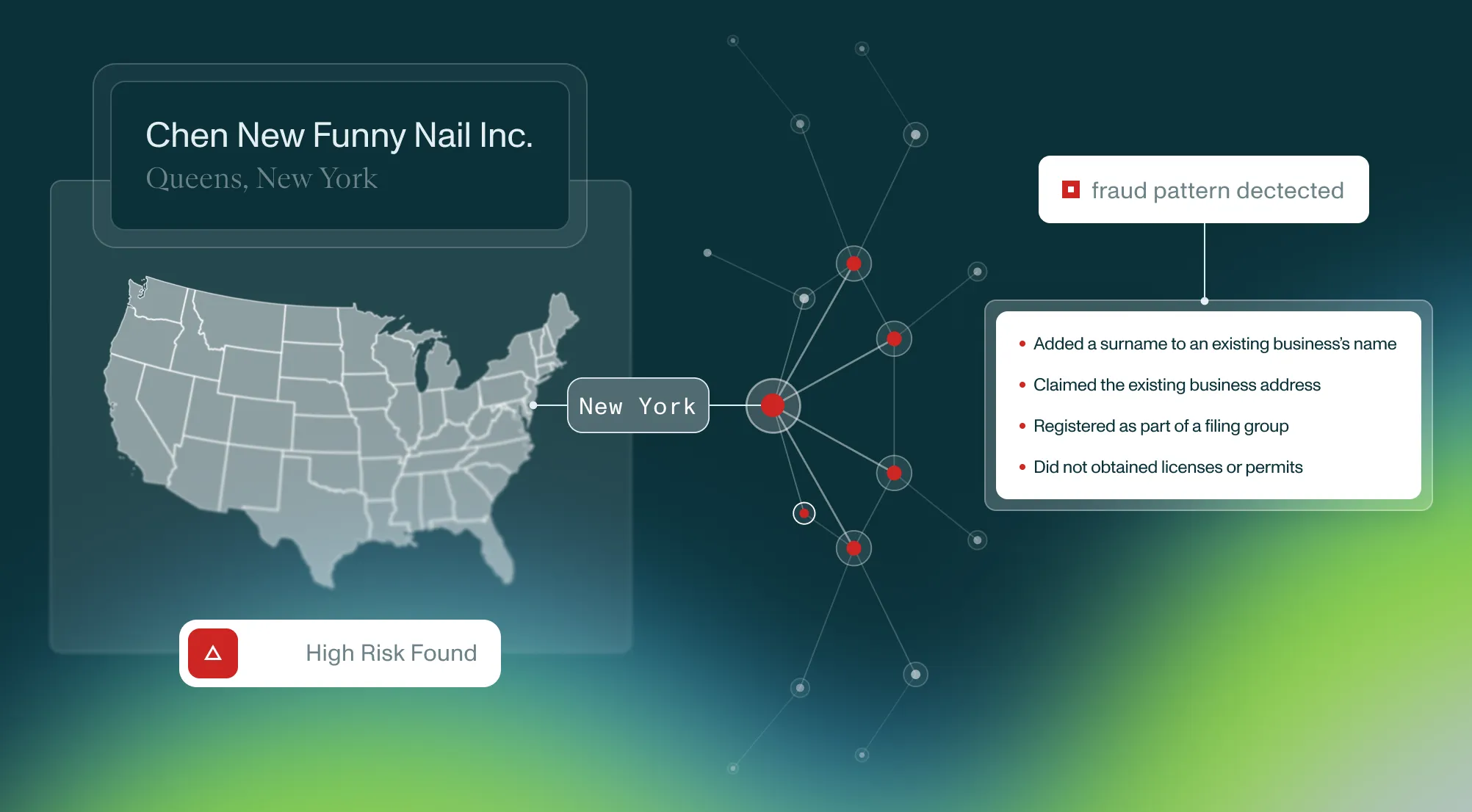
Business identity theft occurs when unauthorized individuals hijack or copy the name, registration records, and credit standing of an established operating company. Unlike synthetic business creation that invents new composite entities, corporate impersonation steals the reputation of an existing enterprise to bypass initial automated credit and onboarding filters.
Catching impersonation early requires underwriting and compliance teams to monitor operational red flags across state corporate registries, business email domains, federal tax records, and applicant signing authority. Under the federal Red Flags Rule, covered financial institutions and creditors must respond appropriately to detected red flags involving covered accounts. The response depends on the risk.
In brief
- Corporate identity theft exploits established company credit history and active state standing to bypass automated onboarding controls.
- Key operational red flags include sudden officer turnover on state filings, newly created lookalike domains, mail drop addresses, and unverified executive signers.
- Registry hijacking alters official state records directly through unauthorized amendments, while lookalike cloning forms a similarly named entity.
- FFIEC examination guidance treats red flags as operational signals requiring out-of-band verification rather than immediate proof of fraud.
The mechanics of corporate identity theft
Corporate identity theft is a specialized commercial fraud scheme targeting established enterprises. Legitimate businesses spend years building trade credit, maintaining good standing with state registries, and establishing vendor relationships. Fraud operators target these enterprises to obtain credit or depository accounts without meeting any time-in-business requirement the lender applies.
Perpetrators extract corporate details from public Secretary of State registries, annual reports, and commercial directories, focusing on companies with active standing but infrequent administrative updates. Fraudsters misappropriate the entity's Employer Identification Number (EIN), formation filings, and trade references while diverting credit lines and loan disbursements to attacker-controlled accounts. The IRS lists unexpected tax transcripts or notices that don’t match anything the business submitted as warning signs of business identity theft.
Primary operational red flags in commercial onboarding
Underwriters and compliance officers can cross-reference commercial applications against independent records as part of risk-based verification. Compliance workflows should monitor specific operational discrepancies that signal potential corporate impersonation:
- Sudden governance and address amendments: Unexpected changes in corporate officers, managers, or registered agents shortly before a major financing application indicate potential registry tampering, especially on dormant charters.
- Domain age and mail exchange (MX) inconsistencies: Email addresses registered on newly created lookalike domains or unauthenticated webmail services point to impersonation when evaluating an established corporate applicant.
- Mailing address and mail drop substitutions: Shifting principal executive offices to a Commercial Mail Receiving Agency (CMRA) or virtual mailbox requires secondary verification for operating companies.
- TIN name and historical address divergence: Submitting an Employer Identification Number that matches the public corporate name but conflicts with historical tax filing records points to stolen entity credentials.
- Unverified signer authority: An applicant claiming executive authority who lacks documented links to the enterprise in state filings or corporate governance records requires enhanced identity verification.
Registry hijacking versus lookalike entity cloning and review procedures
Compliance teams distinguish between registry hijacking and lookalike cloning. In registry hijacking, an attacker submits unauthorized amendments directly to the Secretary of State, changing officers and addresses to seize administrative control of the legal charter. In lookalike cloning, the authentic charter remains untouched while fraudsters incorporate a similarly named entity in another state to deceive lenders and vendors.
Under the FFIEC BSA/AML Examination Manual, red flags indicate circumstances requiring enhanced review rather than definitive proof of illicit activity. When discrepancies arise, institutions should conduct out-of-band verification by contacting historical officers listed on prior filings through independent channels and requesting formal corporate resolutions. Victimized companies can file IRS Form 14039-B (Business Identity Theft Affidavit) tto report suspected tax-related business identity theft to the IRS.
Frequently asked questions
How do fraudsters hijack a business entity's registration?
Attackers exploit state self-filing portals by submitting unauthorized amendment forms or annual reports directly to the Secretary of State. An unauthorized filing can change information shown in the public registry, but it does not give the filer legal authority over the business.
What is the difference between corporate identity theft and synthetic business fraud?
Corporate identity theft exploits a real, established business's existing records and credit reputation. Synthetic business fraud combines real and fabricated data, such as a new charter with a stolen tax ID, to manufacture an entirely artificial entity.
What should a company do if its corporate identity is stolen?
If a state filing was changed without authorization, contact the state filing office and follow its process for reporting or correcting the filing, submit IRS Form 14039-B to report tax-related identity theft, alert commercial credit bureaus, and notify their banking partners.
How can lenders verify applicant authority if an executive is not named in state records?
When an applicant claiming executive authority does not appear on public state filings, institutions perform out-of-band verification. This includes obtaining certified corporate resolutions, reviewing operating agreements, and independently contacting known historical officers through verified channels.

New to Middesk?
Talk to our team to see what business identity intelligence looks like inside your workflow.
Get a demo