Overview
Commercial lenders verify small business industry classifications, NAICS codes, and Merchant Category Codes by comparing loan application disclosures with state business purpose filings, federal tax return codes, and payment processor records. These checks verify that the applicant’s actual commercial activities match the policy criteria of the loan program.
Lenders verify industry codes because self-selected dropdowns and borrower descriptions are frequently inaccurate, outdated, or chosen to bypass credit restrictions. Validating the business’s true operating sector ensures the loan is evaluated under the correct risk scorecard and prevents unauthorized financing of prohibited industries.
In brief
- Lenders verify industry classifications using state charter purposes, tax return codes, and payment records.
- Borrowers often select incorrect codes due to taxonomy complexity or to bypass restricted sector rules.
- Accurate industry codes ensure applications are evaluated under the correct credit scorecard and loss model.
- Automated tools compare filings and website evidence to flag sector discrepancies for underwriter review.
Why industry classification matters in commercial underwriting
A commercial lender uses industry classification to choose the relevant credit scorecard. A seasonal retail shop has different inventory, cash flow, and operating cycles than a software company. Misclassifying the business distorts financial comparisons and underwriting assessments.
Lenders also define industries they choose not to finance. Restricted or ineligible sectors may reflect the lender’s risk appetite or partner requirements, such as sponsor bank guidelines. Originating a loan to a prohibited business can violate policy and create compliance or partnership problems.
Classifying the industry accurately ensures the application is reviewed under the appropriate guidelines from the start.
Why self-reported industry codes often fail
Applications usually ask borrowers to select a code from the North American Industry Classification System (NAICS) or a Merchant Category Code (MCC) description. Self-reported selections frequently fail for three reasons:
- Taxonomy complexity: The NAICS taxonomy contains more than 1,000 distinct six-digit codes. A business owner often chooses a broad category, such as general business services or wholesale trade, because the specific code is hard to find.
- Misrepresentation: A borrower in a restricted or higher-risk category may select a benign code to bypass an eligibility filter or seek lower borrowing costs.
- Changing business operations: Companies often change what they sell over time. An enterprise that started as a local distributor may transition into online retail without updating its original state filings.
Four sources to compare with the application
A reported industry code needs to match what the business actually does. Compare the application with records of its activities, keeping each source’s date and purpose in mind when the descriptions differ:
- State corporate purpose filings: Review the business purpose stated in articles of incorporation and annual state filings. This provides a baseline, though many states allow general-purpose clauses that give little detail.
- Tax return activity codes: Review the six-digit Principal Business Activity (PBA) code reported on federal tax returns (such as Form 1120, Schedule K, or Form 1065). While based on NAICS, this code is self-reported and reflects the primary revenue source declared for that tax year.
- Digital presence and website analysis: Examine the applicant’s active website, service descriptions, and customer terms. Automated tools can scan site content for relevant commercial activities and restricted products.
- Payment-processor records: For operating merchants, check the Merchant Category Code (MCC) indicated on merchant processing statements or derived via automated web classification. This reflects how card networks categorize the merchant’s daily card transactions.
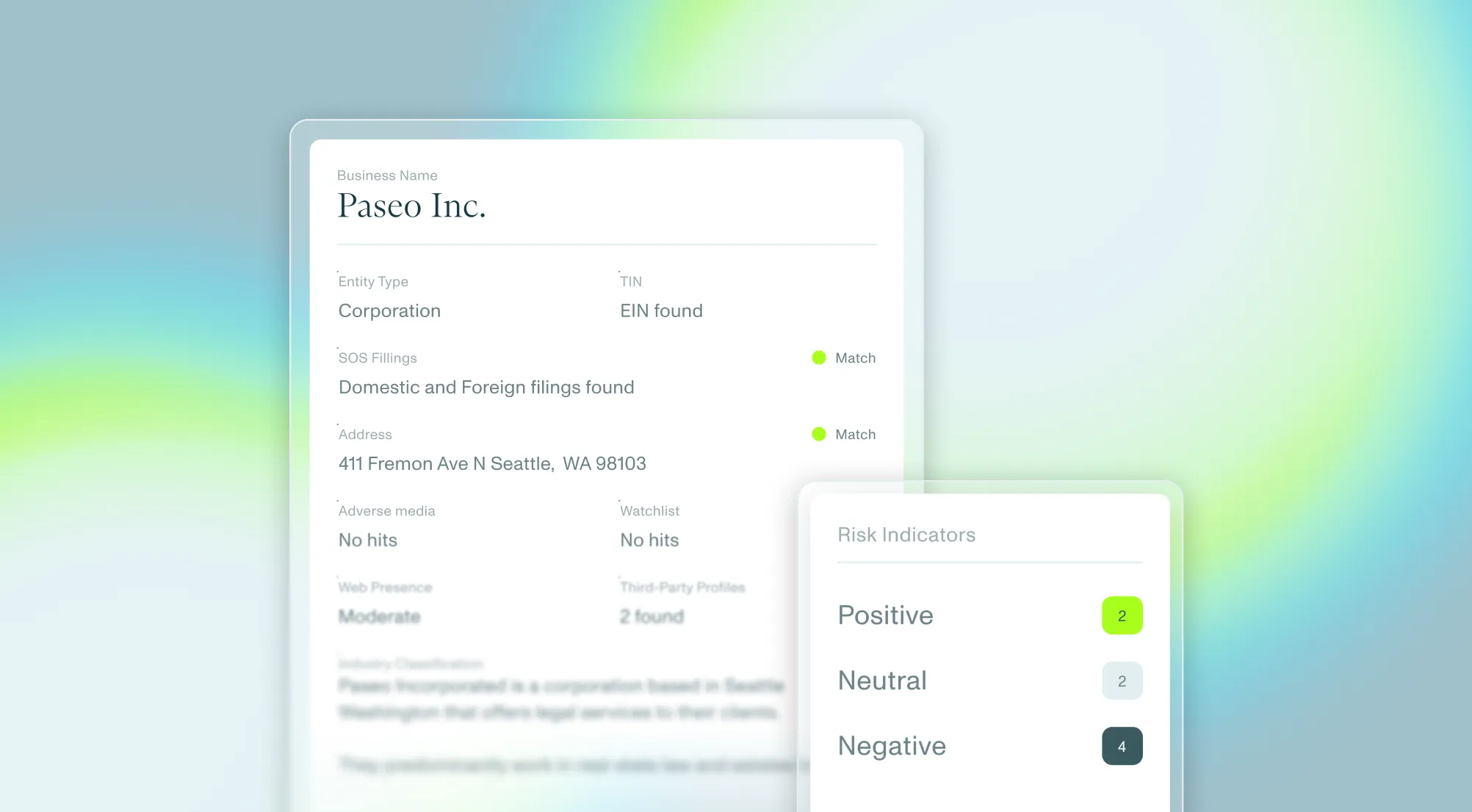
Middesk verifies official business registration and standing, while its Industry Classification and web analysis tools programmatically classify applicants across NAICS, SIC, and MCC taxonomies. By comparing declared codes against analyzed web presence and registry records, lenders flag sector mismatches and automatically route prohibited or high-risk applicants to human underwriters.
Frequently asked questions
What is the difference between NAICS, SIC, and MCC codes?
NAICS is the federal classification standard used by statistical agencies to classify business establishments by economic activity. Standard Industrial Classification (SIC) is an older system that NAICS largely replaced for federal reporting, though some commercial databases still use it. Merchant Category Codes (MCCs) are four-digit numbers used in payment card networks to classify a merchant’s type of business for transaction processing.
Why do businesses misclassify their NAICS or MCC codes?
A business may pick an incorrect code because the list is confusing, because operations evolved, or because the applicant sought to bypass an underwriting rule or qualify for a different rate. Investigate differences between sources rather than assuming every misclassification is deliberate fraud.
Can lenders use website crawling to verify an applicant's business activity?
Yes, as one input among others. Automated tools can scan public website text, service descriptions, and customer terms to see whether the visible business matches the application. Compare the findings with registration, tax, or payment records before drawing conclusions.
What should a lender do when sources show different industry codes?
Compare the dates and scope of each source. A state formation filing may reflect past plans, a tax return reflects a past year, and a website shows current offerings. Route unresolved differences to an underwriter to confirm what the company currently does before applying policy rules.

New to Middesk?
Talk to our team to see what business identity intelligence looks like inside your workflow.
Get a demo