
Overview
Overview
Enhanced due diligence (EDD) is the specialized investigation financial institutions conduct on business customers that present elevated financial crimes, sanctions, or fraud risk. When an applicant operates in a high-risk industry, maintains multi-layered cross-border ownership, or shows adverse public findings, compliance teams must gather extensive documentation before opening accounts or extending credit. Historically, this meant an analyst spent days manually searching court dockets, sifting through adverse media articles, and pulling state corporate records.
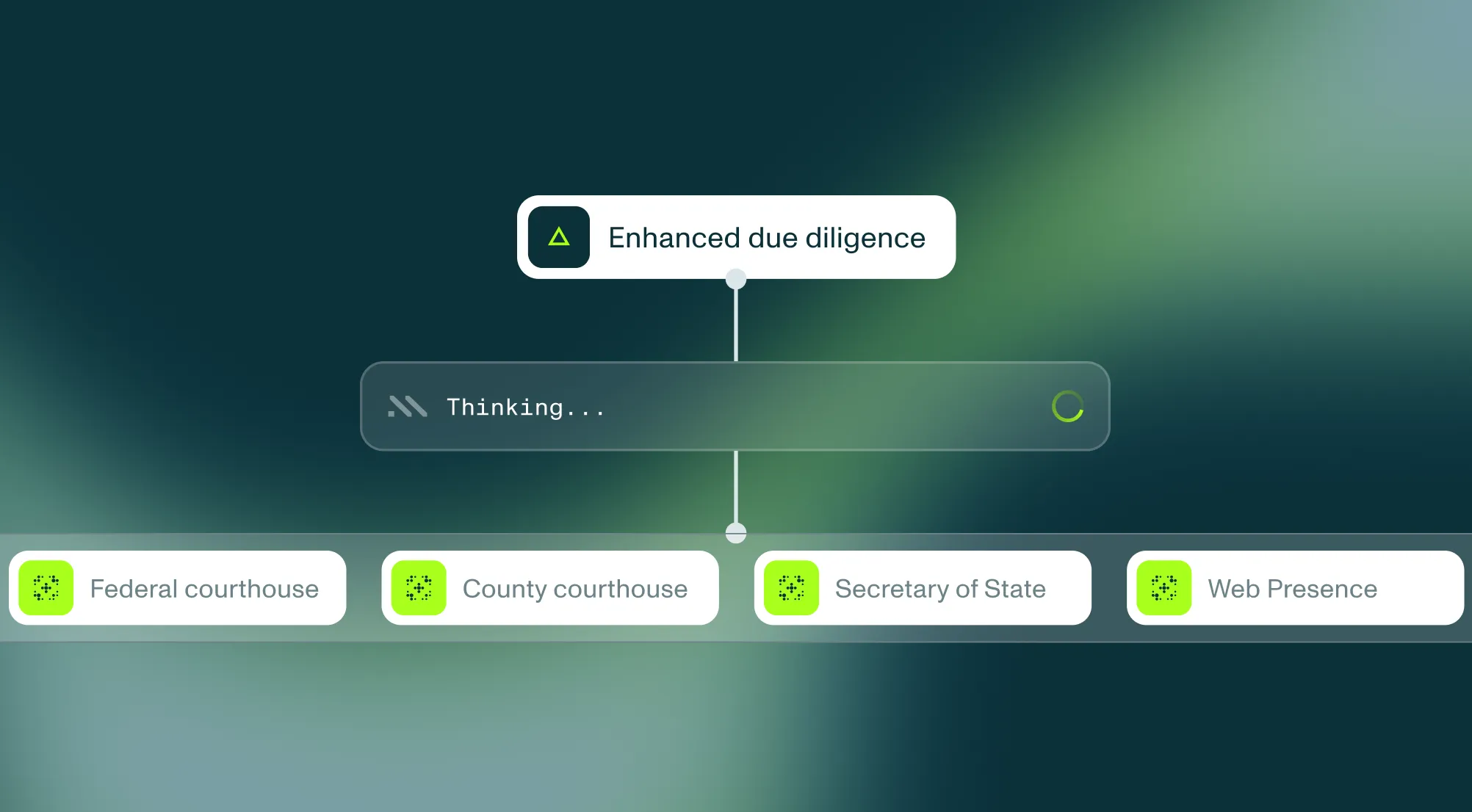
Artificial intelligence agents can automate the research, collection, and synthesis stages of enhanced due diligence. Rather than forcing compliance officers to log into multiple databases, autonomous agents coordinate searches across litigation registries, regulatory watchlists, and corporate filing portals. The agent extracts relevant case details, filters out irrelevant name matches, and compiles an evidence-linked investigative summary. While software coordinates the data assembly, the regulated financial institution retains ultimate responsibility for underwriting the risk and deciding whether to accept the business relationship.
In brief:
- Enhanced due diligence requires deep investigation into high-risk business customers, their beneficial owners, and their operational backgrounds.
- AI research agents automate multi-system searches across court records, bankruptcy dockets, lien registries, and global news sources.
- Effective automation links every material finding directly to primary source passages, timestamps, and docket numbers.
- Compliance officers review synthesized evidence packages to make final risk determinations, eliminating repetitive manual portal lookups.
Focus automated research on specific risk questions
An enhanced due diligence review is not a generic data sweep. Under federal supervisory expectations outlined in the FFIEC CDD examination manual, financial institutions must apply a risk-based approach tailored to the specific factors that make a customer high risk. Depending on the applicant's risk profile, required diligence may include verifying sources of wealth, analyzing anticipated transaction volumes, examining litigation history, or identifying underlying commercial ownership.
Automated agents execute these inquiries by pursuing specific, targeted research plans. Instead of returning hundreds of unorganized search engine results, an agent focuses on the factual question that triggered the enhanced review:
- Court and litigation records: The agent searches federal and state court filings, extracting case captions, filing dates, docket numbers, and procedural outcomes. It distinguishes between an active complaint containing unproven allegations and an entered civil judgment.
- Bankruptcy filings: The agent queries bankruptcy court records to verify whether a debtor is the operating business, a related subsidiary, or an unrelated company sharing a common name.
- Lien and financing statements: Under UCC Section 9-502, a financing statement provides public notice of a security interest but does not establish whether the underlying debt remains active. The agent retrieves the filing history and extracts secured party information for reviewer analysis.
- Public records and legal filings: data for tax liens, litigation, bankruptcy, and Uniform Commercial Code (UCC) lien searches.These records help lenders identify existing claims on assets and legal or financial issues that may affect a lending decision.
- Adverse media: When adverse news triggers review, the agent confirms that the reporting involves the exact corporate entity under review, assesses the credibility of the publisher, and flags subsequent retractions or legal dismissals.
Assemble auditable evidence packages with source citations
The primary risk of applying artificial intelligence to regulatory compliance is the danger of ungrounded or fabricated conclusions. In an enhanced due diligence review, an analyst cannot justify an account approval or file a Suspicious Activity Report based on an unverified chatbot summary. Every material assertion must tie back to an inspectable government record or court docket that can be manually reviewed.
Modern agentic workflows address this by capturing the complete provenance of each finding. As an agent searches official state registries, litigation databases, and corporate archives, it preserves the exact document excerpt, retrieval timestamp, and canonical URL for every relevant finding. If an agent identifies a federal tax lien filed against an operating company, it attaches the county recording number, filing date, and reported tax assessment directly to the case record.
This approach shifts the analyst's role from data gathering to evaluation. Instead of spending hours navigating county court websites, the compliance officer reviews a structured dossier containing highlighted source evidence. If the automated finding indicates low risk and matches pre-defined institutional criteria, the platform can recommend clearance. If the evidence reveals an unresolved fraud indictment or an active corporate dissolution proceeding, the officer has the documentation required to escalate or decline the application.
Establish human review thresholds and regulatory defensibility
Federal regulatory frameworks do not require institutions to process every high-risk application manually from start to finish. However, bank supervisory standards do require institutions to maintain clear policies defining how automated findings are reviewed, who holds authority to approve high-risk accounts, and how discrepancies are resolved.
Institutions maintain audit readiness by configuring granular review thresholds. Routine verification findings, such as confirming that an active litigation was dismissed with prejudice, can be flagged for expedited clearance. Complex findings, such as undisclosed holding entities located in secrecy jurisdictions or unresolved federal sanctions inquiries, automatically route to senior compliance committees.
Middesk Agents automate these investigative workflows while keeping human compliance teams in full control. By deploying specialized research agents that search official state records, tax filings, and legal registries, Middesk gathers primary documentation and synthesizes evidence into structured risk dossiers. Compliance officers can configure default pause policies to inspect findings before acting, giving institutions the speed of automated investigation with the defensibility of human-reviewed decisions.
Frequently asked questions
Does enhanced due diligence require a universal set of background checks?
No. Regulators expect institutions to apply risk-based due diligence tailored to the customer's specific risk profile. While legal and financial searches are common, a review may prioritize supply chain counterparties, beneficial ownership structures, or cross-border payment flows depending on the business model.
Does using an AI agent transfer regulatory compliance responsibility to the software vendor?
No. Regulated financial institutions retain full legal responsibility for their compliance decisions. Software vendors provide investigative tools and data aggregation, but the institution's compliance officers must establish risk policies and validate that automated findings satisfy regulatory obligations.
How does an AI agent resolve ambiguous name matches across court records?
When a corporate name matches multiple legal filings, an agent compares secondary identifiers, such as state of incorporation, registered agent addresses, corporate officer names, and filing dates. If the available records do not definitively confirm whether the filing involves the customer, the agent leaves the finding unresolved and surfaces the ambiguity to an analyst.
When should an institution refresh an enhanced due diligence review?
Institutions refresh due diligence based on established review schedules or event-driven triggers. Common triggers include material changes in corporate ownership, unexpected spikes in transaction activity, or new negative news and sanctions designations.

New to Middesk?
Talk to our team to see what business identity intelligence looks like inside your workflow.
Get a demo