Overview
Businesses expand one employee at a time.
A new hire moves to a new state. The company registers for withholding and unemployment insurance. Payroll begins. Another state gets added to the compliance footprint.
Then the employee leaves.
The payroll stops, but the state payroll tax account often does not.
Until the employer formally closes it, the account may continue generating zero-dollar filing requirements, notices, renewal fees, and penalties for returns the company did not realize it still owed.
An inactive account is not necessarily a closed account.
In brief:
- State payroll tax accounts can remain active after the last employee leaves.
- Open accounts may continue to require zero-dollar returns and annual reconciliations.
- Year-end is a useful checkpoint, but employers should close eligible accounts promptly rather than wait for December 31.
- Middesk can manage state-specific closure workflows, status tracking, and confirmation artifacts where available.
Open accounts create active obligations
It is easy to assume that a state payroll tax account becomes dormant when payroll reaches zero.
State agencies often see it differently.
In California, an employer that may hire again must continue filing quarterly reports showing no payroll. If the employer fails to file, the Employment Development Department may presume it still has employees and assess the account. Once the account is properly closed, future returns and wage reports are no longer required for periods after the closure date.
Wisconsin similarly requires employers with active withholding accounts who file quarterly, monthly, or semi-monthly to submit deposit reports even when no tax was withheld.
The work continues because the account remains open—not because the company still has an employee there.
The cost is bigger than a filing penalty
The most visible risk is a fine. The larger cost is the operational drag that builds around it.
Every unnecessary state account can create another return to track, another credential to maintain, another notice to investigate, and another agency deadline for payroll or finance teams to manage.
When a filing is missed, the company must determine whether the notice is correct, reconstruct its payroll history, contact the agency, and resolve the account. A zero-dollar obligation can still create hours of work.
For an SMB with limited payroll, finance, and operations capacity, that work comes directly out of running the business.
Closing the account removes the obligation and preserves team productivity.
Why year-end is a useful checkpoint
December 31 is not a universal state closure deadline.
It is an operating deadline.
Year-end gives companies a natural moment to compare two lists:
- The states where they currently have employees.
- The states where they still have open payroll tax accounts.
Anything on the second list but not the first deserves review.
Completing that review before another calendar year begins can prevent an inactive account from rolling into another quarter, annual reconciliation, or renewal cycle. It can also leave payroll and finance teams with a cleaner state-account inventory for the new year.
But employers should not wait for year-end if an account is already eligible for closure. Final-return deadlines can begin when wages stop. California may require final filings within 10 days in certain circumstances, while New York and Wisconsin commonly require certain final payroll filings within 30 days.
The right time to close an account is after the underlying payroll obligation ends—and before another reporting period begins.
How to close an account cleanly
Closing a state payroll tax account is more than changing its status in payroll software.
The employer may need to:
- Confirm the last date wages were paid in the state
- Identify each open withholding, unemployment, or combined tax account
- File required final returns and annual reconciliations
- Pay outstanding balances
- Submit the agency's closure request
- Complete any employer verification or signature step
- Retain confirmation that the agency accepted the closure
The sequence and submission method vary by state. Some agencies support online closure requests. Others require paper forms, fax submissions, or direct employer action.
That variation is what makes closures easy to postpone and difficult to manage across multiple states.
Business registration has a lifecycle
Businesses don't just enter states. They leave them, too.
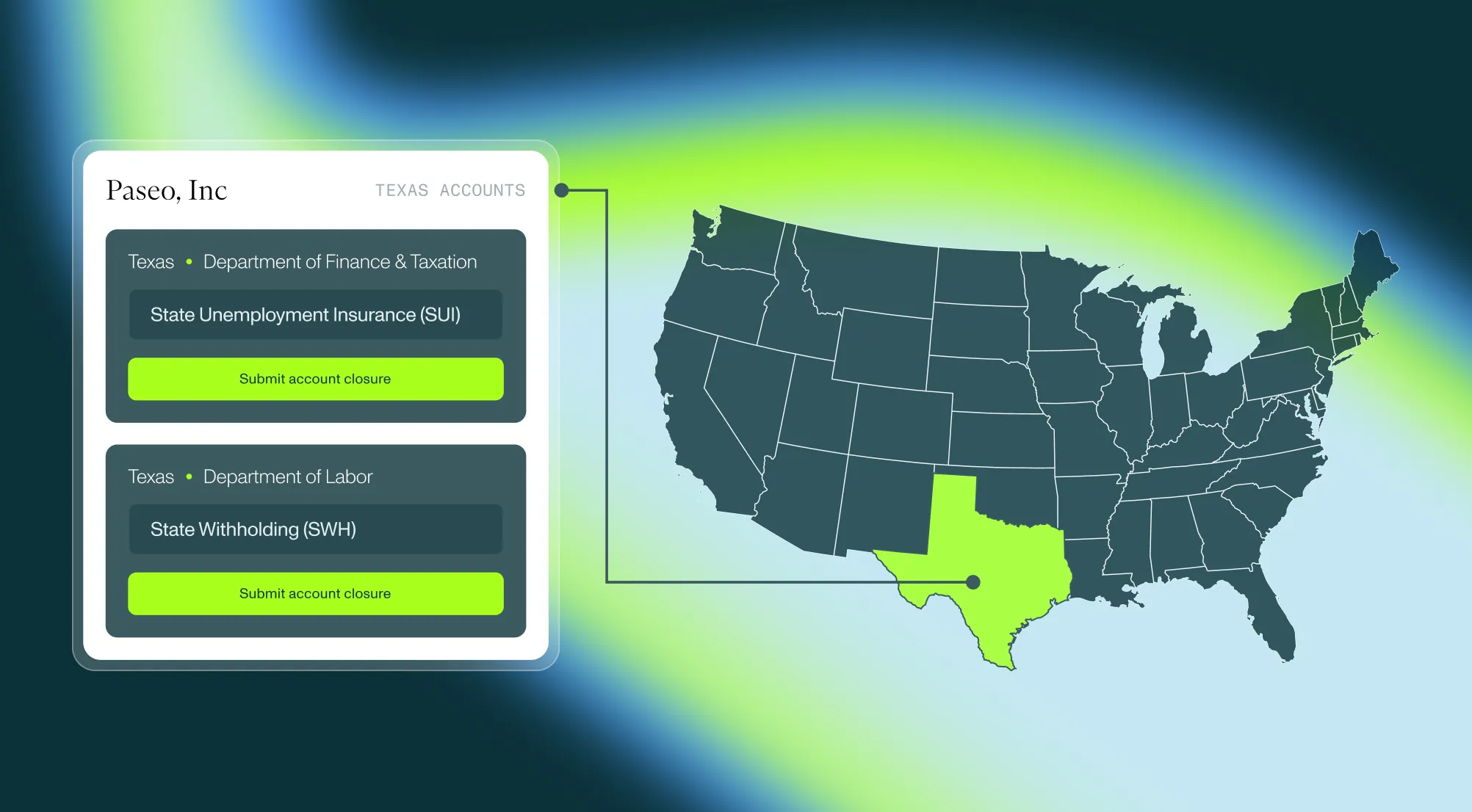
Middesk Business Registration helps customers manage both phases of that lifecycle. Employers can request closures for state unemployment insurance, state withholding, and combined payroll tax accounts. Middesk collects the required information, manages the state-specific workflow, tracks status, and stores confirmation artifacts where available.
When an agency requires the employer to take a step directly, Middesk provides instructions and tracks the process.
This is state payroll tax account closure. It's not an entity dissolution, a merger or acquisition, an EIN change, or a company-wide wind-down. Those events may require separate legal, tax, or accounting support.
The goal is simpler: when a company no longer has employees in a state, it should not keep carrying an account it no longer needs.