
Overview
Overview
Know Your Business (KYB) onboarding frequently stalls when an application contains minor discrepancies or missing paperwork. Compliance teams will usually pause the application for manual review when a company registers under one formal name but operates under a trade name, or when a submitted address conflicts with state corporate filings. A compliance analyst is then forced to open public registries, locate the relevant records, and read through filings to confirm the company's operating identity.
Artificial intelligence reduces this review burden by automating the investigative legwork rather than replacing the reviewer. Instead of waiting for an analyst to manually search state filing portals or pull tax records, AI agents retrieve the relevant corporate documents, extract the necessary entity identifiers, and present the supporting evidence directly to the reviewer. Automating these repetitive data collection and comparison steps allows compliance teams to clear legitimate discrepancies in minutes while maintaining complete human oversight.
In brief:
- Manual KYB reviews typically stem from simple document anomalies, unregistered trade names, or mismatched registration addresses.
- AI models extract structured entity data from unstructured documents, such as PDF files, and compare them directly against primary state records.
- Automated investigation agents retrieve supporting filings and highlight matching passages, eliminating repetitive manual portal searches.
- Compliance analysts retain final decision authority, reviewing pre-assembled evidence packages rather than conducting raw research.
Automate document extraction and baseline record matching
During commercial onboarding, businesses submit formation certificates, operating agreements, and utility bills to prove their legal existence and operating address. Analysts historically spent hours manually opening these files, typing registration numbers into state databases, and verifying that corporate seals and filing dates aligned with government records.
The use of optical character recognition (OCR) paired with modern document understanding models automates this initial extraction process. When an applicant uploads a document, the software reads key corporate identifiers, including legal entity names, state charter numbers, and principal addresses, and cross-references them against official databases. For banks and regulated lenders, federal CIP requirements permit institutions to combine documentary and non-documentary verification methods. Automating the extraction of these fields allows the system to verify active legal standing instantly, filtering out clean applications and flagging genuine data mismatches for review.
Investigate trade names and address discrepancies with AI agents
When an application does trigger a review, the delay usually stems from ambiguity rather than outright fraud. A small business might submit a commercial application using its public-facing brand name while its legal entity is registered under an unfamiliar corporate holding name. In a standard workflow, an analyst must search Secretary of State assumed-name databases to prove that the two names belong to the same entity.
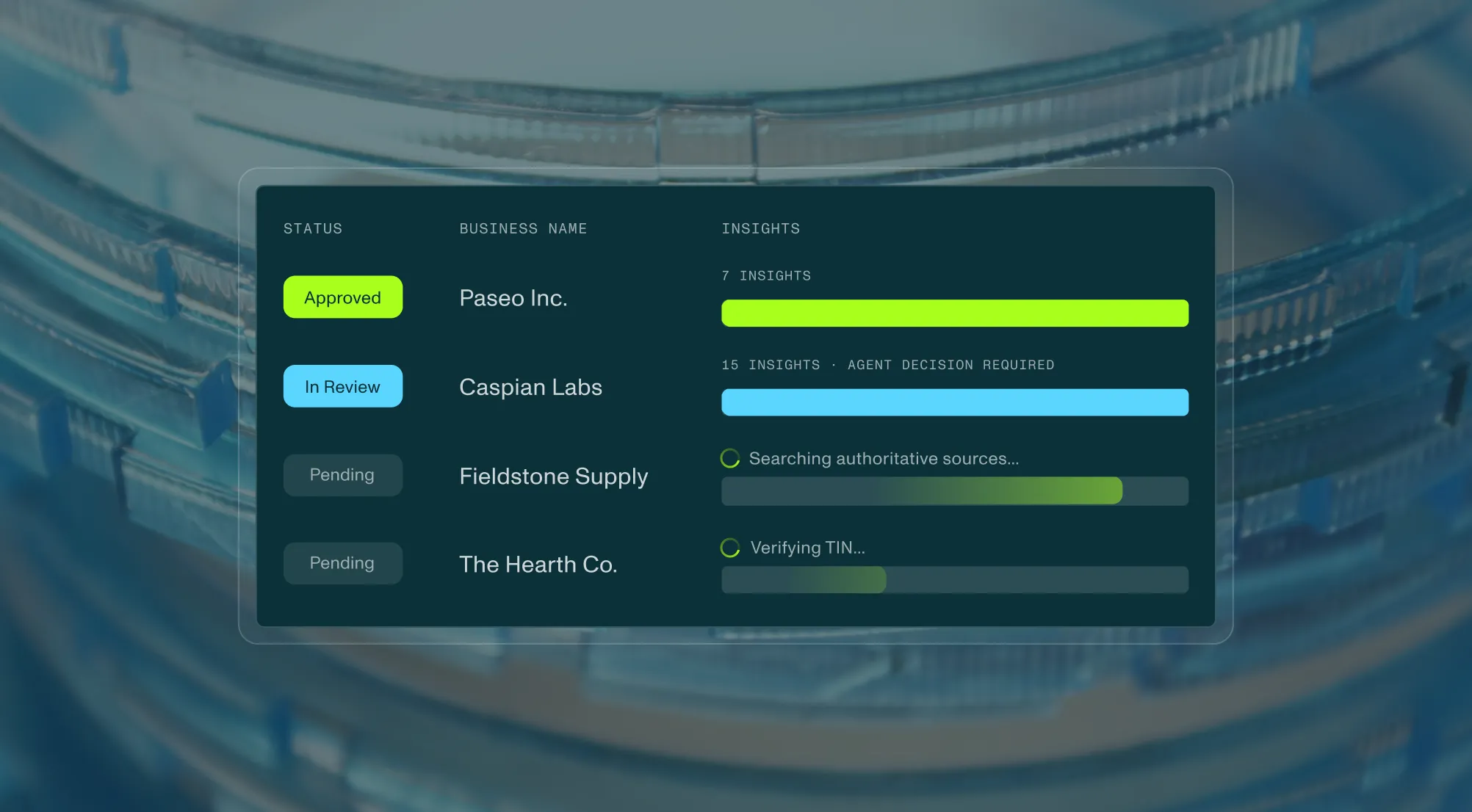
Autonomous research agents handle this multi-step investigative process without human intervention. When an application uses a trade name instead of the company's legal name, an agent searches state corporate filings to locate the assumed-name or DBA record that connects the two. The agent extracts the matching corporate identifier, records the filing date, and attaches the primary source link directly to the application.
A similar workflow resolves common physical location questions. When an applicant lists a commercial mailing address, postal records from the USPS delivery point validation system can identify whether the address corresponds to a Commercial Mail Receiving Agency (CMRA) or a physical suite. Rather than forcing an analyst to look up the property, AI tools pull property records, business license filings, and corporate registrations to determine whether the business maintains genuine operations at that location.
AI delivers source-backed evidence directly to human reviewers
The primary objective of automated KYB tooling is not to eliminate human oversight, but to eliminate the manual research that slows it down. Regulated institutions remain legally accountable for customer identification and due diligence decisions. Automating approvals blindly without an audit trail introduces unacceptable compliance and credit risk.
Effective platforms address this by delivering complete, source-backed evidence packages directly to review queues. When an analyst opens a flagged application, they do not see an opaque risk score or a simple pass-fail badge. Instead, they see the specific question that triggered review, alongside the exact corporate filings, filing dates, and highlighted text passages that resolve it.
Middesk provides the core verification and agent infrastructure that powers this workflow. By connecting directly to official government registries across all fifty states and federal tax authorities, Middesk verifies legal entity standing and extracts officer details in real time. When an application presents conflicting records, Middesk Agents conduct autonomous research across official public sources, returning structured evidence with confidence scores and source citations so compliance teams can resolve reviews quickly and defensibly.
Frequently asked questions
Which KYB review tasks benefit most from AI automation?
The highest-leverage tasks are repetitive public record lookups. This includes searching state assumed-name databases to verify trade names, cross-referencing registered agent addresses, and extracting corporate details from uploaded formation certificates. Automating these steps removes the manual research burden from compliance teams.
Can AI agents automatically approve commercial business applications?
Yes, but only under institution-defined policy rules. Platforms allow risk and compliance teams to configure automated clearance rules for low-risk applications that meet specific data verification thresholds. Applications involving complex ownership structures, negative news, or unresolved registry discrepancies continue to route to human analysts for final approval.
How do compliance teams verify that an AI finding is accurate?
Defensible AI workflows require every finding to cite its primary source. Rather than trusting an automated summary, compliance analysts inspect the retrieved state registry record, corporate filing timestamp, or document excerpt attached to the case.

New to Middesk?
Talk to our team to see what business identity intelligence looks like inside your workflow.
Get a demo