Overview
Commercial lenders verify a business’s operating age and annual revenue by comparing loan application claims with state filing histories, bank records, and authorized tax transcripts. These checks verify that the business has an established track record and sufficient cash receipts to support loan payments.
Lenders verify time in business and revenue because self-reported applications and unaudited statements can misstate actual operating history. Formation filings confirm legal existence dates, while direct bank transactions and tax transcripts distinguish real commercial receipts from transfers, loans, and shelf-company age.
In brief
- Lenders verify legal formation through state registries and verify trading history through continuous bank records.
- Direct bank account feeds confirm current customer receipts and distinguish sales from account transfers.
- Authorized tax transcripts provide an independent record of revenue reported to federal tax authorities.
- Cross-referencing filing dates with financial records identifies shelf companies and unverified operating claims.
Separate legal formation from operating history
A shelf company is a previously formed company kept inactive for later use. Its formation date may be old even when the current business has only recently begun trading. Ask for records of operations rather than using the age of the legal entity as the whole answer.
State filings show legal formation and available status history. Filing gaps or reinstatement can raise questions, but they do not prove when the company traded. Compare those dates with sales, bank activity, and other evidence of operations.
Amendment filings may show changes in officers, registered agents, or addresses. Ask what changed and whether the current application describes the same operations. A move or leadership change alone does not establish that the business was dormant or acquired to misrepresent its age.
Verifying commercial revenue: moving beyond self-reported statements
Reported revenue needs to be checked against records covering the same business and period. Compare borrower-provided statements with authorized bank or tax records, checking account ownership and coverage before investigating differences:
- Bank transactions: Review the history available for the lender’s required period. Identify customer receipts separately from loan proceeds, owner contributions, and transfers between accounts. Investigate uncertain categories rather than assuming automated labels prove revenue.
- Tax transcripts: Form 4506-C requests tax return information through an authorized Income Verification Express Service (IVES) participant with taxpayer authorization. Compare the relevant return information with financial statements for the same period. A transcript confirms what was reported, not that every reported sale occurred.
Use verification results to resolve gaps
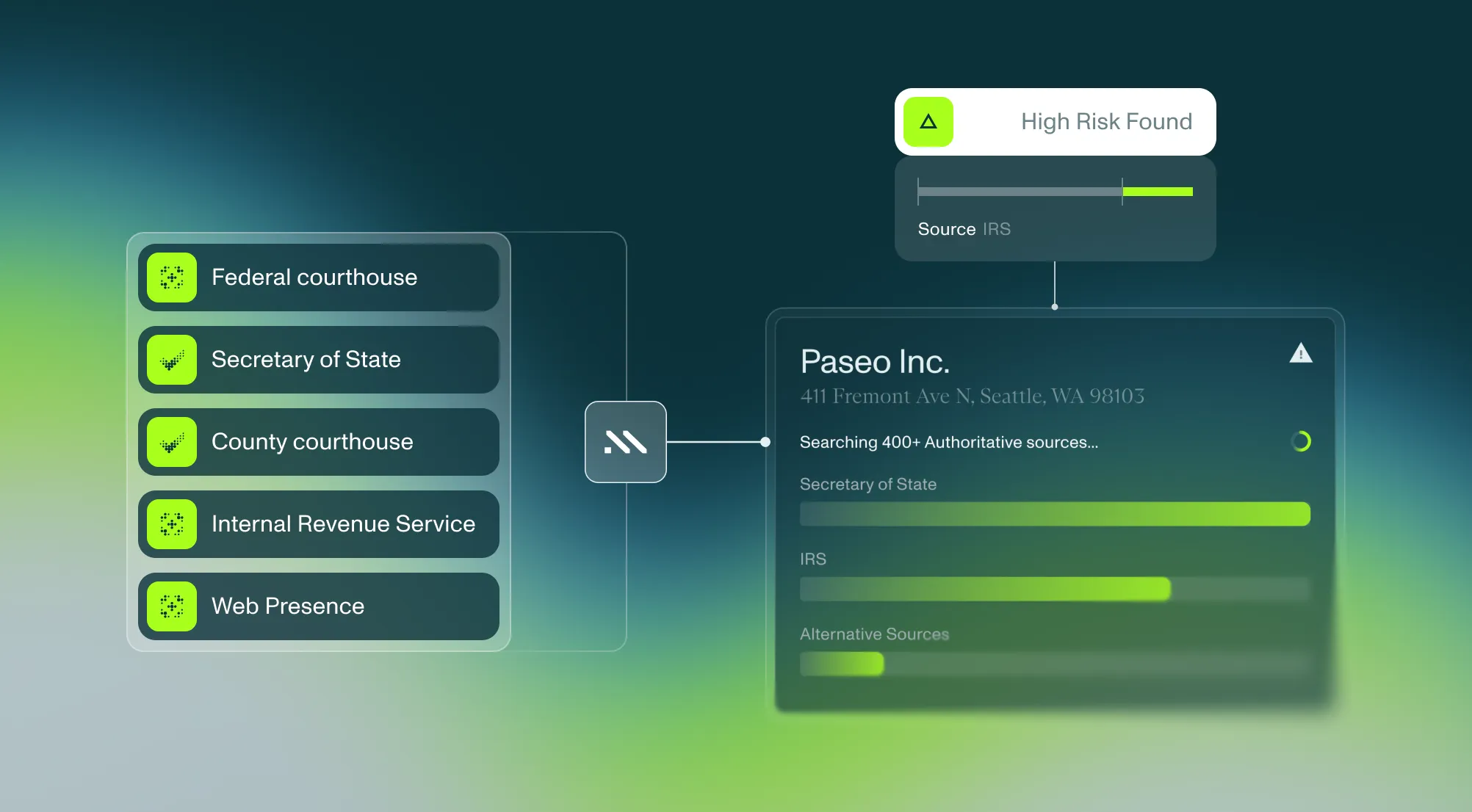
Middesk’s business verification includes formation dates and registration status. Lenders can use those records to compare the application with state information, then request operating evidence where the legal history does not answer the tenure question.
Document how the evidence supports the claimed start date and revenue period. If the records cover only part of the requested history, identify that gap instead of treating an old formation date or a recent deposit total as a complete answer.
Frequently asked questions
How do lenders detect fake bank statements in SMB loan applications?
Compare uploaded statements with bank-sourced records obtained with the borrower’s permission. Document-analysis tools may flag inconsistencies, but a flag is not proof of alteration. Resolve differences in dates, balances, or transactions before relying on the statement.
Can a business use a shelf company to bypass time-in-business requirements?
An old formation date can make a newly operating business look established if the lender checks only legal age. Review operating records for the period claimed. Changes in officers or addresses can prompt questions, but they do not prove a shelf-company scheme.
What is the difference between gross revenue and net cash flow in underwriting?
Gross revenue measures sales before expenses. Net cash flow measures cash received minus cash paid during a period. It is a change in cash, not the account balance, and it can include financing or other non-sales activity. For repayment analysis, distinguish operating cash flow from loans and owner contributions.
Can payment-processor records help verify revenue?
They can help reconcile customer payments for the channels they cover. Compare sales, refunds, disputed payments, fees, and settlement timing with bank deposits and accounting records. Processor data may omit cash sales or sales handled elsewhere, so do not treat one feed as total revenue.

New to Middesk?
Talk to our team to see what business identity intelligence looks like inside your workflow.
Get a demo