
Overview
Middesk Business Risk allows organizations to conduct a deeper evaluation of a business before onboarding. It draws on dozens of data points covering a business’s identity, online web presence, operations, industry, reputation, and relationships.
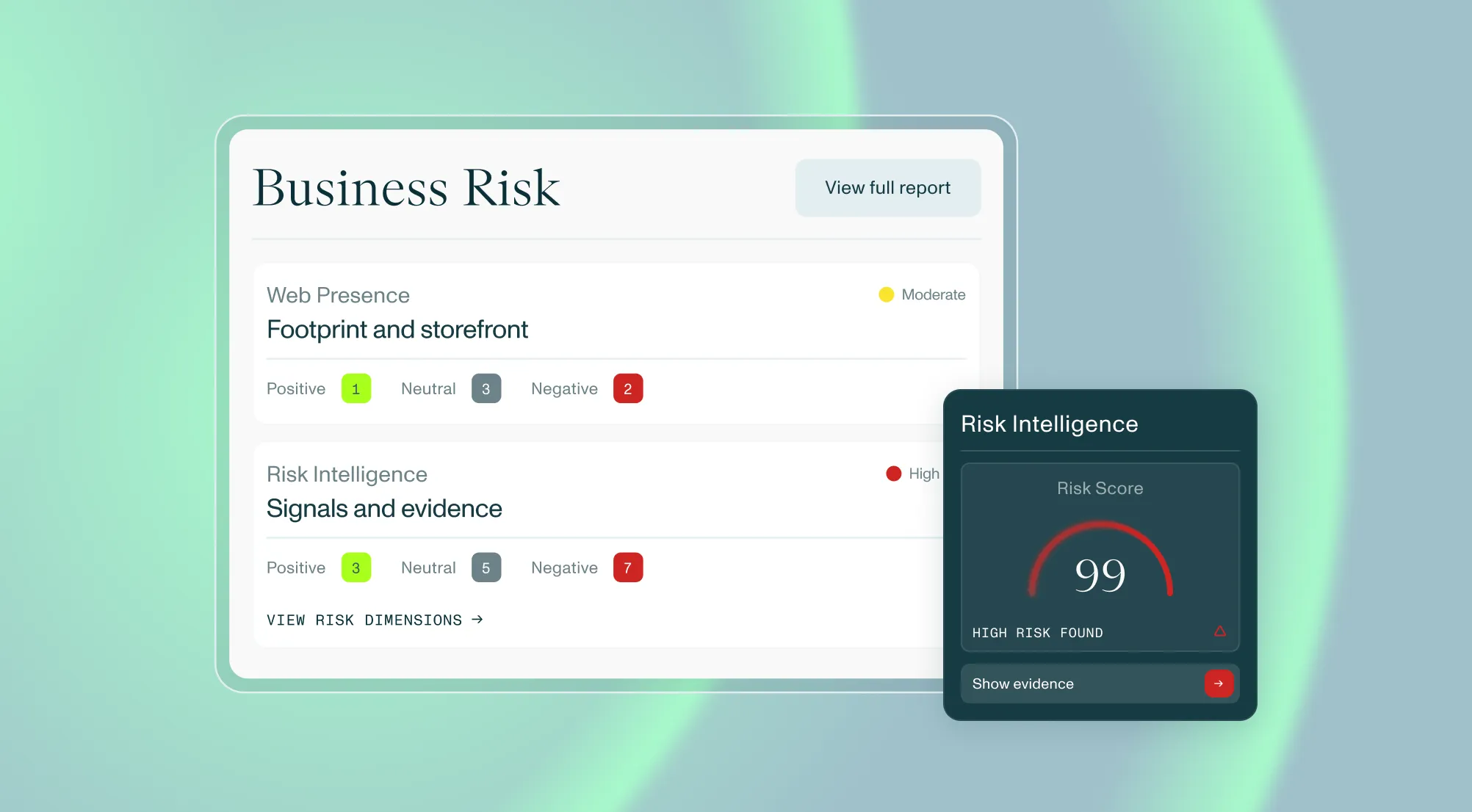
Business Risk shows up on the Middesk platform as a dashboard report with an overall risk score and a summary of the major findings. A report page gives users an analyst read of those findings alongside Business Verification and other summaries. A Risk Intelligence page organizes the factors behind the score into six dimensions and shows the evidence backing each finding.
Reviewers can also inspect other granular data such as domain information, storefront details, third-party profiles, sanctions and adverse media, and patterns in customer reviews when available. The customer decides how the application proceeds.
Mounting fraud cases continue to show why legal existence is not enough to verify a business identity. A company can appear in public registration records while using a borrowed identity, a shared address, a thin online presence, or relationships that only become suspicious when several businesses are examined together.
In brief:
- Business Risk adds operational, online, reputational, and relationship evidence to business verification by gathering dozens of data points that can say more about a business.
- The product returns a report dashboard with a cumulative score. It also provides a Risk Intelligence page, organized into six dimensions with contributing factors, and source evidence for review.
- Business Risk informs customer-owned onboarding decisions so they can identify applications that warrant closer examination, reduce avoidable exposure, and decide which businesses should enter their network.
What risk signals does Business Risk evaluate?
The dashboard gives reviewers an overall score and the main findings with multiple analyst-read summaries on the report page. The details that teams need to review a more complex application live in the Risk Intelligence page. Together, these dimensions explain what Business Risk found and why it produced that score.
The six dimensions of Risk Intelligence:
- Transaction Laundering and Fraud looks for indicators associated with undisclosed commercial activity, including domain risk, e-commerce functionality, policy language, storefront technology, and contact information.
- Merchant Identity and Entity Integrity examines whether the business behind the website matches the identity it presents.
- Compliance and Regulatory Risk surfaces sanctions, watchlists, litigation, and other regulatory concerns.
- Content and Business Model examines what the business appears to sell and whether its website aligns with its stated industry.
- Reputational and Brand Risk draws from reviews, complaints, adverse media, and other public information.
- Operational Risk looks for evidence that the business is functioning as described, including its storefront, web traffic, and contact details.
Reviewers can open the evidence behind each finding. Available evidence can include granular data such as domain age, traffic history, product count, payment technology and ratings, among many others.
How does the Business Risk score work?
Business Risk evaluates measured information about a business using a proprietary risk model that weighs dozens of signals, including from the business’s identity, registration history, addresses, domain, and other available evidence. The model returns a numbered score to show a low, moderate or high risk score.
The score brings the findings together, but the evidence helps reviewers distinguish a warning sign from an ordinary explanation.
For example, the Risk Intelligence page in the report dashboard shows the measured factors that had the greatest influence on the model-backed Transaction Laundering score. Each factor includes the observed value and whether it raised or lowered the score. The page may show whether Middesk detected a parked or newly registered domain, risky phone information, limited website content, or e-commerce functionality. The displayed factors explain the strongest influences on the result.
Customer testing determines how the score should affect onboarding. An organization can compare Business Risk scores with outcomes from previously reviewed applications. It can measure how many risky and legitimate businesses different thresholds would flag, and decide which results should prioritize review, require more information, or trigger another customer-defined action.

Assess risk earlier
Business Risk expands the view of a business within Middesk, bringing verified identity, web presence, industry context, risk indicators, and supporting evidence together in one place.
Learn moreWhy your organization needs Business Risk
Criminals register legal entities, borrow names and addresses from legitimate businesses, create convincing websites, and submit information that matches public records. Each detail may look ordinary on its own and legitimate upon first inspection. The risk often becomes visible only when multiple attributes are examined together.
Standard verification may confirm that an entity exists without establishing that the applicant controls the business, operates as described, or has legitimate relationships with the people and companies connected to it. Risky businesses that pass an initial check can later result in financial losses, investigations, remediation work, and damage to customer trust.
The White House recently reported that its task force uncovered nearly $230 billion in suspected fraud and stopped $56 billion in fraudulent payments, a signal of how much suspicious activity can reach government and financial systems before detection. Mastercard’s recent Merchant Trust Services program also reflects a broader effort to identify risky merchants earlier based on multiple signals about a business and its physical and online footprints.
Business Risk addresses that earlier decision point. It gives organizations more evidence before onboarding so they can identify applications that warrant closer examination, reduce avoidable exposure, and decide which businesses should enter their network. It cannot determine with certainty that an applicant is a criminal. It can make the warning signs harder to miss.