
Overview
Business identity cloning can combine facts that are individually real: a government registration, a commercial address, a recognizable name, and the online history of an operating company. The falsehood lies in the claimed relationship among them.
Starting with six company names from an indictment, Middesk found at least 30 New York corporations that stole an existing business’s name and registered at its street address. Thirty-one appeared in same-day filing groups of three or more.
The pattern resembles one identified by the United Kingdom’s Companies House, which found 786 suspected clones of established restaurant businesses formed between December 2023 and February 2024.
In brief:
- Middesk compared 530 New York corporations with earlier businesses and found dozens that reused both a business name and address. Nearly all were filed in same-day groups.
- The records establish a repeated registration pattern. They do not identify who filed or controlled the companies, prove coordination, or show that the companies opened bank accounts or moved money.
- Companies House identified 786 suspected restaurant-company clones formed in the UK in three months; agencies in Michigan, California, and Colorado have also issued enforcement actions or public warnings about business identity theft.
Six company names became a statewide search
Prosecutors found 97 bank accounts connected to an alleged fraud scheme in Queens, New York. Most were registered under business names, and the Queens district attorney’s release named six of them.
Middesk used those six names as a starting set. The state records showed no single person or address connecting all six, but the corporations shared a formation pattern.
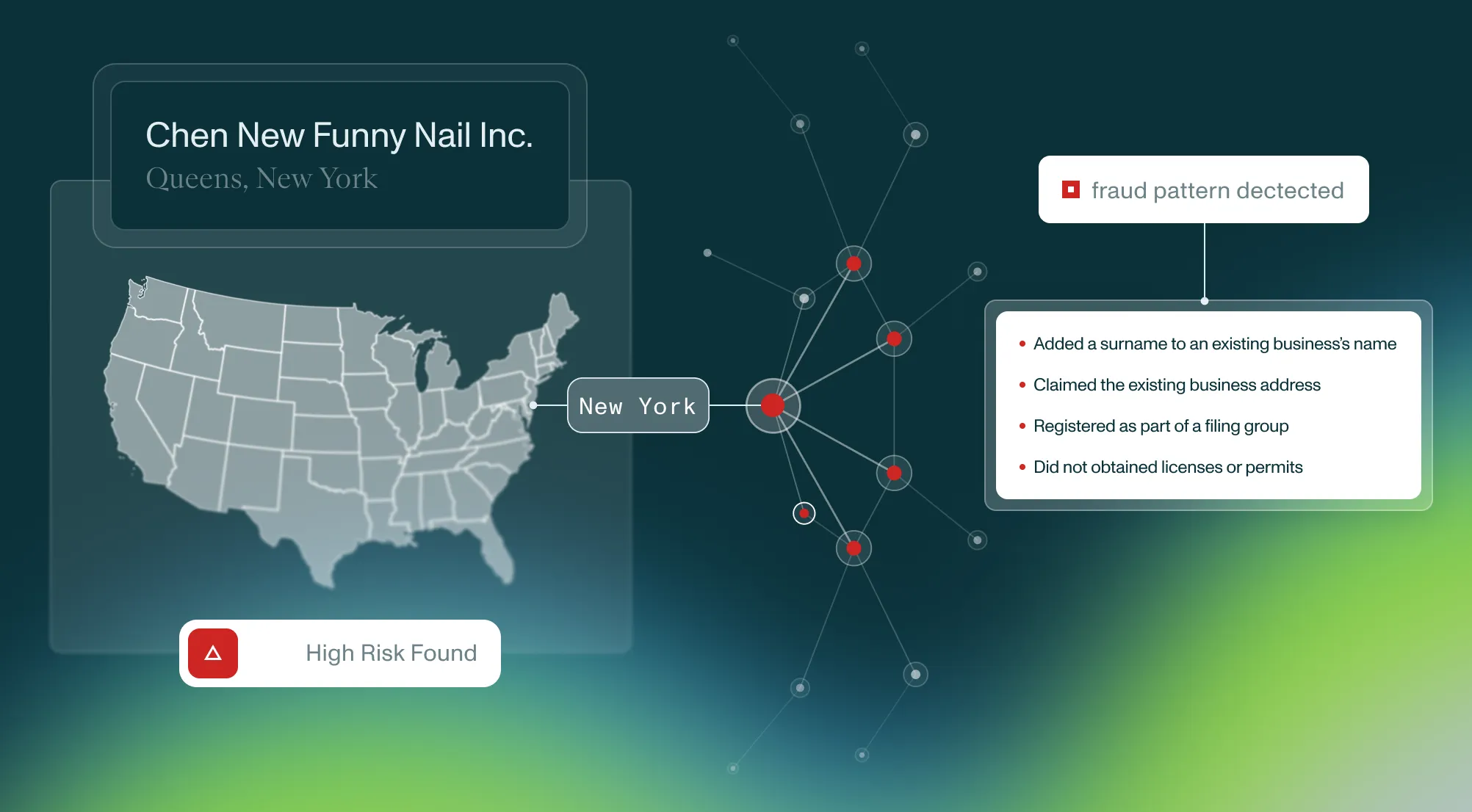
One was Chen New Funny Nail Inc. New York records showed an earlier nail business called New Funny Nail, Inc., at the same Bronx address. The later corporation added “Chen” while retaining the earlier business’s name and address. The state records do not identify who filed or controlled the later corporation, and nothing in the available evidence implicates the earlier business or its owners.
The fraudulent company managed to bypass verification checks at a major U.S. bank.
Middesk tested how often new corporations use a similar pattern:
- Added a surname to an existing business’s name
- Claimed the existing business address
- Registered as part of a filing group
- Did not obtain licenses or permits consistent with operating there.
Middesk’s entity graph connected registrations to names, addresses, people, filing dates, licenses, and permits, allowing each corporation to be compared with earlier businesses and the wider filing population.
The pattern appeared in more than 30 corporate filings
Middesk selected 530 New York corporations whose names began with a common surname and whose service-of-process field used a placeholder such as “The Company” or “The Corp.” The selection did not use filing dates or addresses.
More than 30 of the 530 corporations added a surname to an earlier state-registered business’s name and listed that business’s recorded address. The matched businesses included salons, spas, restaurants, takeaways, and delicatessens across New York State.
Filing-group size produced the clearest difference. The name-and-address pattern appeared in none of the 150 corporations filed alone, one of the 94 filed in pairs, and 31 of the 286 filed in groups of three or more. Comparing corporations in the same broad trade and three-month period produced a similar result: batch-filed corporations were about 10 times as likely to fit the pattern.
More than 8,000 New York companies formed in the nail, spa, beauty, salon, and barber trades from 2021 through 2024. More than 400 were registered at locations where another business held an appearance-enhancement license. No later license was found for the new corporation or one of its officers.
Current sales-tax permits added another clue. More than 40% of the 530 corporations shared an address with a physical permit held by a differently named taxpayer, while about 1% had a permit in their own name. Because the permit data is current, it cannot show which permits were active when a corporation filed.
Dated websites, reviews, and archived pages confirmed individual cases that corporate records missed. These sources helped when a storefront’s operating name did not appear in the registry or an address used a different abbreviation. They could confirm cases, but not measure how common the pattern was across every comparison group.

Assess risk earlier
Business Risk expands the view of a business within Middesk, bringing verified identity, web presence, industry context, risk indicators, and supporting evidence together in one place.
Learn moreWhat did not distinguish the companies
An address match alone did not identify the pattern. About 32% of the target set and 33% of comparison companies shared an address with a differently named business.
Multiple corporations filing at the same building within weeks also failed as a signal. Comparison companies did this more often, reflecting ordinary arrangements such as shared ownership, business succession, or several businesses operating from one property.
Early analysis also used filing dates to help find cases, making it unsuitable for testing whether same-day filing was unusual. Middesk replaced it with the 530-company population selected without dates or addresses.
No single feature reliably distinguished the corporations. The durable signal combined a copied name, the earlier business’s address, and concentration in same-day filing groups. That combination supports further review; it does not prove identity theft, coordination, ownership, business activity, or a crime.
How genuine records can support a false business identity
A corporate registration can be real. The address can belong to a real storefront. The name can lead to years of reviews and photographs. A verification process still needs to establish whether the applicant is entitled to use that identity and operating history.
State authorities have pursued cases or published warnings about businesses created or altered with another company’s identity. Michigan alleged that cloned LLCs copied legitimate companies’ names and addresses to intercept checks and deposit them into bank accounts. California warned that fraudulent state filings can change a business’s address or officers to help open credit lines, and Colorado has said thieves may create a new company using a victim’s name and address to obtain credit from banks or retailers.
Other governments have found the same tactic at scale. Companies House identified 786 suspected clones of established restaurant businesses formed in the United Kingdom in three months and said cloned companies are commonly used to deceive financial institutions and open accounts under false pretenses.
The FDIC Office of Inspector General advises banks investigating this type of fraud to check whether a business is registered and has a website. Those checks remain useful, but they examine individual facts. Comparing a new corporation with earlier businesses, similar names, filing groups, officers, agents, licenses, and permits can expose relationships that isolated record checks miss.
The pattern is an investigation trigger, not proof of fraud. The records do not identify the filers or establish shared ownership, bank-account activity, or money movement.