Overview
In brief:
- United States regulations require financial businesses to be able to identify high-risk entities prior to onboarding them
- One of the most effective ways to detect these high-risk businesses is through Adverse Media Screening & Enhanced Screening
- Adverse Media Screening & Enhanced Screening tools like Middesk can help provide the data needed for this, score the risk for you, and automate this process at scale
Screening potential business clients for high risks including links to criminal activity, sanctions, political exposure, and negative news are critical components of a company’s Customer Due Diligence (CDD) and Know Your Business (KYB) processes. These processes are required to assess a customer’s risk both during onboarding, and throughout the lifecycle of the business relationship.
The CDD process involves checking various sources for involvement with criminal activity, while KYB procedures are designed to prevent criminals from disguising the proceeds of crime. Per FinCEN regulations, financial institutions are legally required to perform sanctions, Adverse Media, and Politically Exposed Persons (PEP) screening at onboarding, in addition to ongoing monitoring and reporting of suspicious activity.
Let’s start with some background on the regulations the businesses must follow when trying to perform risk and compliance screening for their customers during onboarding:
What regulations require businesses to conduct risk and compliance screening?
Regulations in the U.S. that require risk and compliance screening are made up of multiple acts, and requirements, spread across a few regulatory bodies. These are the key ones to know about:
FinCEN CDD Final Rule
The FinCEN CDD Final Rule requires that financial institutions and businesses operating in regulated industries conduct ongoing Customer Due Diligence, and this includes monitoring new and existing customers for illegal activity.
USA PATRIOT ACT 2001 Customer Identification Program (CIP)
In 2001, the USA PATRIOT Act required Financial Institutions (FIs) to develop policies for how customers can open an account, and what information must be collected from them before they review that customer for risk. To fulfill the requirements of the USA PATRIOT ACT, most businesses use a Customer Identification Program (CIP).
PEP/RCA screening
Part of assessing risk includes reviewing the people involved with the business or Ultimate Beneficial Owners (UBOs) to determine if they are associated with any high-risk activities.
Performing a PEP (Politically Exposed Persons) risk assessment identifies individuals in positions of prominent influence or power, as they are more likely to be involved in bribery or corruption.
Financial institutions should also identify Relatives and Close Associates (RCAs), as a PEP may act through a friend or family member to disguise illicit activity.
Identifying someone as a PEP or RCA does not prohibit a company from doing business with them, but they are required to conduct additional due diligence and monitor their transactions for indicators of criminal activity.
OFAC List & Watchlist RCS screening
Sanctions and global watchlist screening is the process of checking a business and its associated people against government sanctions lists, such as the U.S. Office of Foreign Assets Control (OFAC) List, and other criminal watchlists.
Financial institutions are legally prohibited from doing business with sanctioned entities, and screening against global watchlists further mitigates risks of exposure to financial crime.
Find out how to run an OFAC check so you can automate receiving business verification details.
Why is Adverse Media Screening & Enhanced Screening needed?
An Adverse Media Search, or negative news search, scans the internet for media sources indicating risks of involvement with financial crime, terrorism, or other negative factors for the business and its associated people.
Adverse Media screening is a regulatory requirement for businesses operating in regulated industries, and it is an effective practice to reduce reputational risk for any company, regardless of industry. Adverse Media Screening may reveal whether a person or business has a history of involvement with criminal activity, such as money laundering, terrorist financing, or fraud.
Many companies that operate in unregulated industries, such as crypto, also choose to conduct Enhanced Screening to reduce their exposure to financial crime.
CDD and AML checks are highly manual today and, therefore, resource-intensive for compliance teams, so many companies are looking for an automated solution to streamline their processes.
Challenges of Adverse Media Screening & Enhanced Screening
There are a number of challenges businesses face when trying to include Adverse Media Screening and Enhanced Screening into their KYB program:
1. It’s time consuming, especially with a lack of automation
Screening for adverse media, PEPs, and sanctions can be a time-consuming and challenging process if you have to search multiple sources, sort through false positives, and monitor high-risk customers for suspicious activity.
As a company grows and its operations scale, manual processes can’t keep up with the volume of customer data that needs to be screened, leading to long backlogs for compliance teams and negatively impacting the customer experience.
Many companies rely on manual processes to manage PEP and sanctions screening and ongoing monitoring, making it challenging to keep track of changes in sanctions lists and PEP statuses. Sourcing relevant details to identify a PEP, filtering through false positives, and monitoring high-risk customers can be incredibly time-consuming and burdensome processes for compliance teams.
Manual checks also present a greater risk for human error, and flaws in screening processes may allow sanctioned entities and bad actors to remain undetected.
2. Poor data coverage and freshness leads to poor risk assessment
Many existing screening solutions have limited coverage of criminal watchlists and PEP or RCA profiles and may require periodic manual updates to databases. Stale data adds friction to the onboarding process, creating unnecessary delays for legitimate customers while also increasing the likelihood that bad actors slip past controls undetected.
3. International vs domestic regulatory requirements are difficult to navigate
Regulatory requirements vary by jurisdiction, but in the U.S., regulators encourage screening of both domestic and international PEPs and RCAs.
If a company suspects a PEP or RCA may be engaged in money laundering or financial crime, they are required to submit a suspicious activity report. Companies who fail to do so are at risk of fines, regulatory penalties, and reputational damage.
While financial institutions are legally bound by AML regulations to implement sanctions screening, it is illegal for any U.S. company to conduct business with a sanctioned entity, so sanctions screening is essential regardless of industry.
Failing to identify a sanctioned party can lead to significant regulatory fines and penalties. While most businesses conduct sanctions checks at onboarding, companies such as payments processors must also screen individual transactions for sanctions.
Some companies choose to further mitigate risk by screening international sanctions and criminal watchlists, in addition to domestic lists such as OFAC.
4. Navigating Adverse Media Screening through an oversaturation of online data
Traditionally, many compliance teams have relied on manual searches, but the sheer volume of media sources adds significant noise, a high chance for false positives, and makes it incredibly challenging to conduct a complete and accurate review.
Adverse Media data sources also often lack credibility, and are sometimes only accessible in certain regions or hidden behind a paywall.
Because regulations lack concrete guidance on how to conduct adverse media screening, compliance analysts are often left to make assumptions, leading to subjectivity in the decision-making process. All of these factors make adverse media searches time-consuming and costly for compliance teams when conducted manually.
Best practices for customer risk screening
Here are some the things you should focus on when conducting your customer risk screening, both during onboarding and throughout the customer lifecycle:
- Screening should take place at onboarding and on an ongoing basis - A business owner might not have been on a PEP List when you onboarded them, but if they later appear on one, it was still your responsibility to know that happened
- Ensure customer data is accurate and up-to-date - The best way to achieve this is through Perpetual KYB and ongoing compliance practices
- Pull from a variety of unique/original data sources - A combination of both authoritative and alternative KYB data sources is the best way to get the most comprehensive data coverage in a risk assessment
- Set minimum requirements for data accuracy and freshness - And then audit your KYB data vendor to ensure they can handle your organization’s unique data requirements
- Choose a solution with customizable configurations - You should be able to set up rule-based risk decisioning that can meet your organization’s unique needs and minimize false positives
- Develop a risk screening framework - This should standardize onboarding decisions and ongoing reviews, leveraging risk insights and scores to ensure consistency
Middesk’s Enhanced Screening and Adverse Media risk screening tools
Automated, customizable screening solutions are the answer to meeting regulatory requirements and reducing risk without overwhelming your compliance team. That's why we built Adverse Media and Enhanced Screenings, two products that are now available as an add-on to Middesk Business Verification and can be reordered at any point in a customer’s lifecycle to maintain ongoing compliance.
What Middesk Adverse Media can do
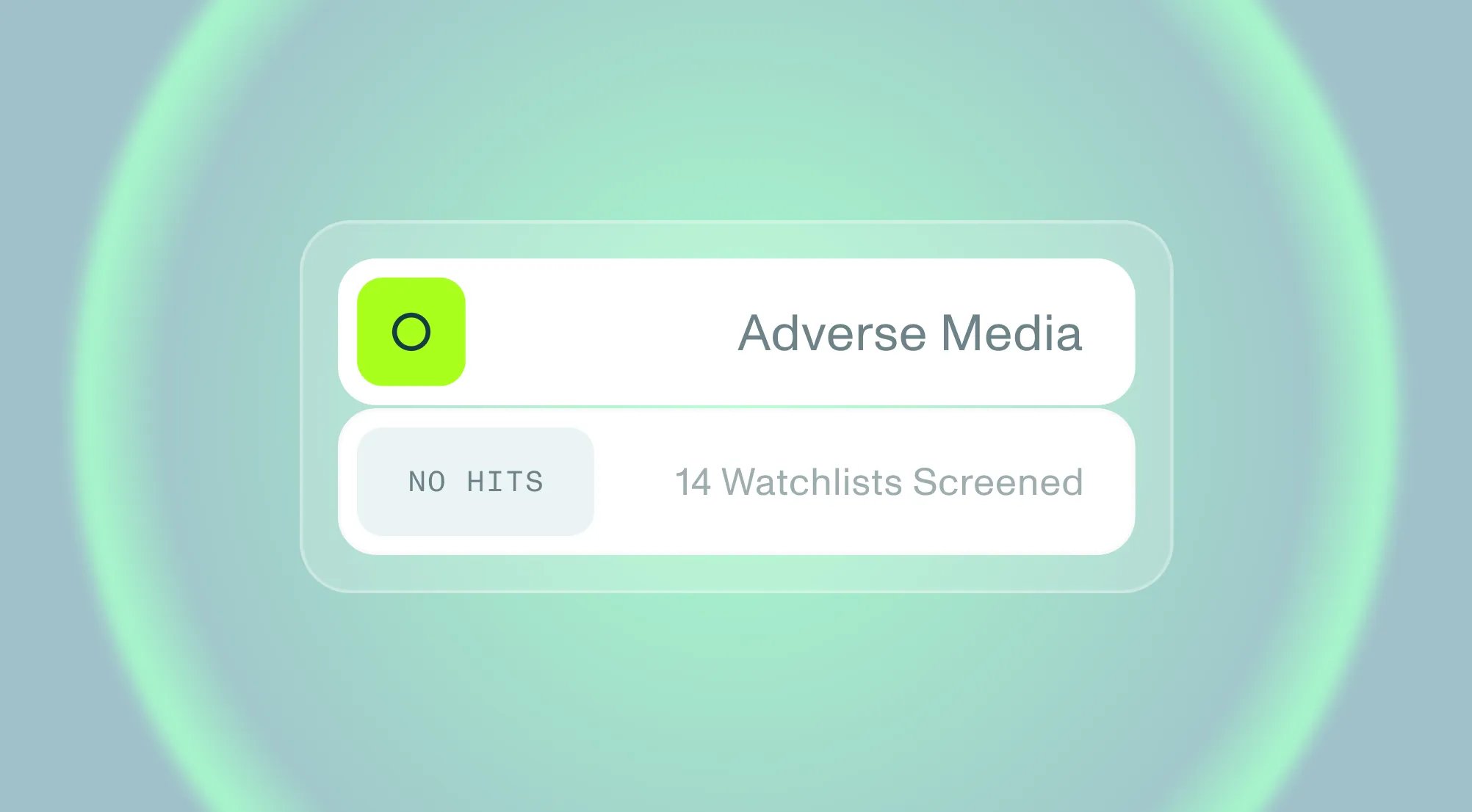
Adverse Media allows you to automatically uncover public risks associated with customers by screening millions of articles for news related to a business and its associated people.
Middesk’s Adverse Media product provides an automated, comprehensive search on business and people names, with 2X the coverage compared to other options on the market, and uncovering new articles within minutes of publication.
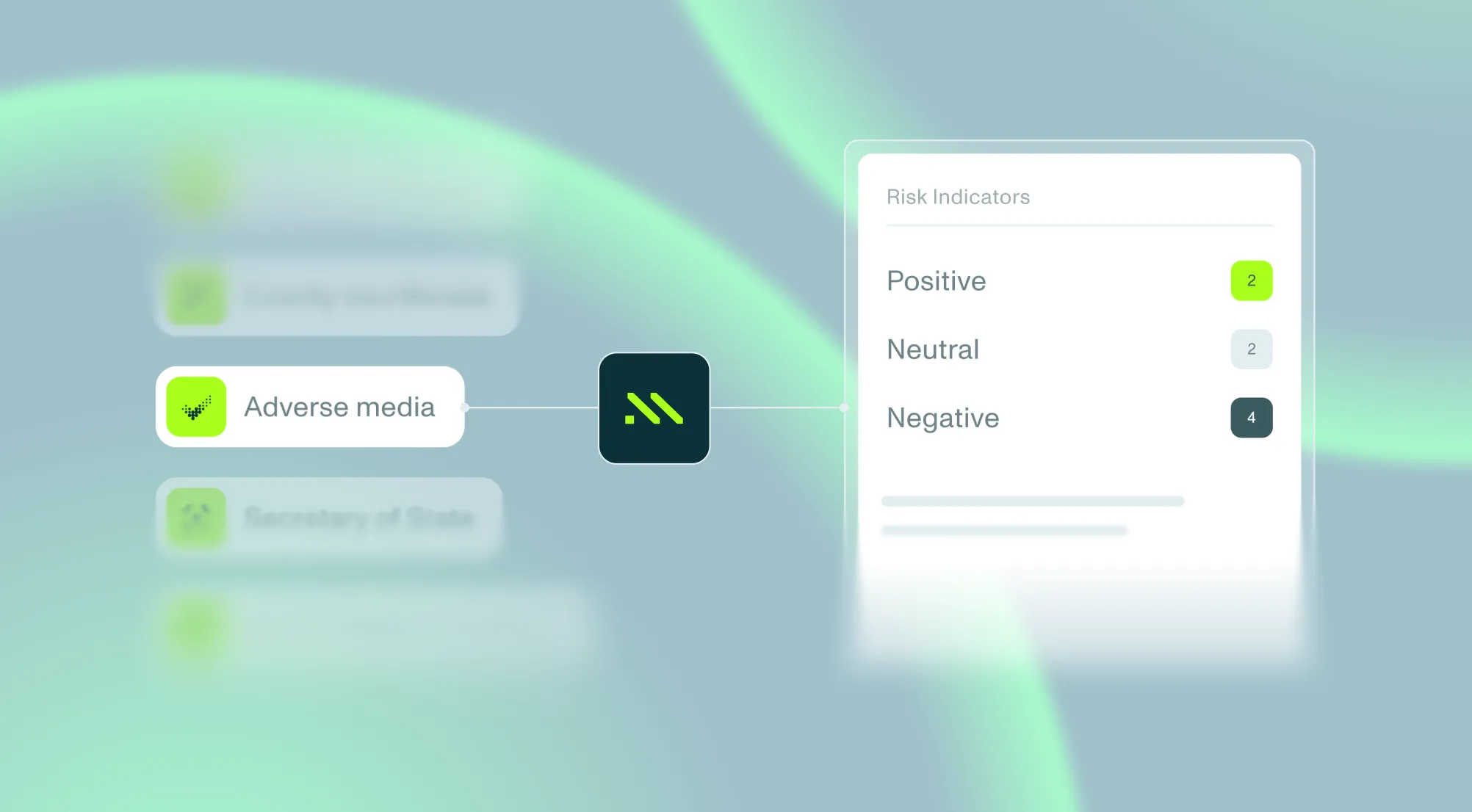
Our Adverse Media search surfaces media sources along with risk scores and categories, quickly identifying potential links to money laundering, terrorist financing and other financial crimes.
Adverse Media contains unique risk insights and tools that empower your compliance team to conduct efficient reviews and standardize the decision-making process. Adverse Media Insights include:
- Aggregated risk scores for each business and individual
- Direct links to media sources
- Sentiment score (positive, neutral, or negative) and risk category for each media source
What Middesk Enhanced Screening can do
Enhanced Screening provides rich PEP insights and identifies whether the business or its associated people appear on global sanctions lists or watchlists, expanding upon the U.S. sanctions lists included within Business Verification.
With Enhanced Screening you can quickly surface potential links to sanctions, corruption, or money laundering. Middesk’s comprehensive watchlists coverage includes over over 6000 domestic and international sources spanning sanctions, criminal, arrest, and debarment, and more than 2 million global PEP and RCA profiles.
With Enhanced Screenings, you can be confident that you’re building a full picture of people with prominent positions of influence and minimizing exposure to sanctioned parties. Enhanced Screenings Insights include:
- Name of each sanctioned party, relevant watchlists, and direct link to the watchlist source
- Rich PEP and RCA profiles presented in a structured format, including birthplace, aliases, associations, professional history, name match scores, and direct links to source data
Why use Middesk for risk and compliance screening?
More comprehensive coverage shouldn’t come at the cost of a greater burden on compliance teams, so we’ve designed our solutions to help customers reduce false positives and noise.
Middesk’s customizable configurations allow you to select only the watchlists that are in-scope for your organization and specify your risk tolerance. We leverage our best-in-class business identity data to further reduce false positives with the inputs to our Enhanced Screenings search. Our customizable configurations allow you to tailor the solution to meet your organization’s needs, and adapt as regulatory requirements and business needs inevitably change over time.
Automating KYB, CDD, and AML tasks help organizations to streamline complex reviews, scale operations, and avoid costly mistakes. Middesk’s business verification and screening capabilities provide the most relevant information, fresh data, and rich insights, empowering your company to make informed decisions when building and maintaining B2B relationships.
To learn more about our complete, automated solution, get in touch with our sales team.
All Middesk services are subject to the Middesk Terms of Service. Beta services may be subject to additional terms and conditions.