

Overview
In brief:
- A Secretary of State API is a tool that allows businesses to request information from all SOS online portals in the U.S. at once
- SOS APIs are used by fintechs, lenders, banks, marketplaces, and payment providers, allowing them to verify the identity of a business to assess the risk of onboarding them
- SOS APIs speed up the business verification process significantly, while reducing the risk of human error
Companies in the U.S. that are compelled by Know Your Business (KYB) regulations are required to verify the identity of businesses they are onboarding, including checking that the business is a legally-registered business. The only way to do that accurately is with direct access to the Secretary of State offices, where U.S. businesses have to be registered at the state level.
Unfortunately, getting business information online from Secretary of State portals is filled with challenges like non-standardized user interfaces, account registration requirements, and fee payments. But there’s a better way to get business information from Secretary of State online portals: using an SOS API.
Let’s first talk a bit more technically about what Secretary of State APIs are and how they work.
What is a Secretary of State API?
A Secretary of State API is a software that allows an application to query business-related data directly from any U.S. Secretary of State office. This is often used by companies that want to validate a business’s details for identity verification and risk assessment purposes.
A Secretary of State API’s purpose is to speed up business verification for companies that onboard businesses on a larger scale, making manual KYB reviews unsustainable. It’s also beneficial for companies that work with customers all across the U.S. rather than in a single state, because it gives them access to verify information against all SOS databases, rather than looking through each one individually.
The main advantage of using a Secretary of State API is that it forgoes the need to search for this information at each Secretary of State office individually. This is a time-consuming process that often requires registering for multiple separate accounts and repeatedly paying fees for searches.
How do Secretary of State APIs work for business verification?
An SOS API lets the user input identity information about a business—like its name and address— select the types of information objects to return, and then run a query. The API will then search each state’s online SOS portal for the information, and then report on what it finds.
It can report on things like which SOS portal(s) the information was found in, whether the information is from an active or inactive business, or whether the business is missing registration details. It can also check information it returns against the input data for inconsistencies, and flag those.
As you can imagine, the quality of this data has a big impact on how effectively you’re able to leverage this data and scale your automation efforts. Make sure you thoroughly vet your KYB vendor through data testing to ensure they’ll meet your standards.
What does an SOS API do that’s different from traditional business verification software?
There are two key differences of a Secretary of State API tool from a business verification tool: the automation and speed it can retrieve information, and the way you receive the information.
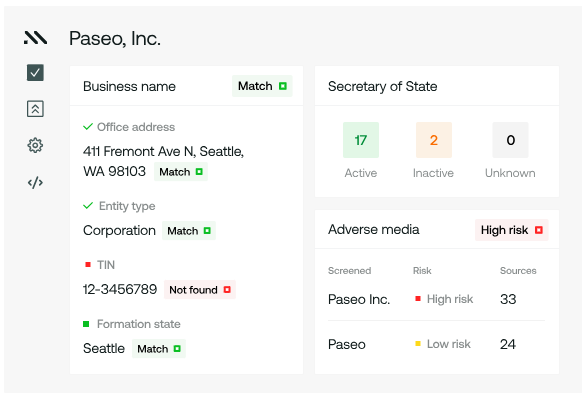
In a traditional business verification tool where you aren’t using an API, you will likely input or order information about a business, and receive a ‘report’ on the business in a dashboard. It will show you the information you are looking for, and verify if what you were looking for is true.
In Middesk, that looks something like this:
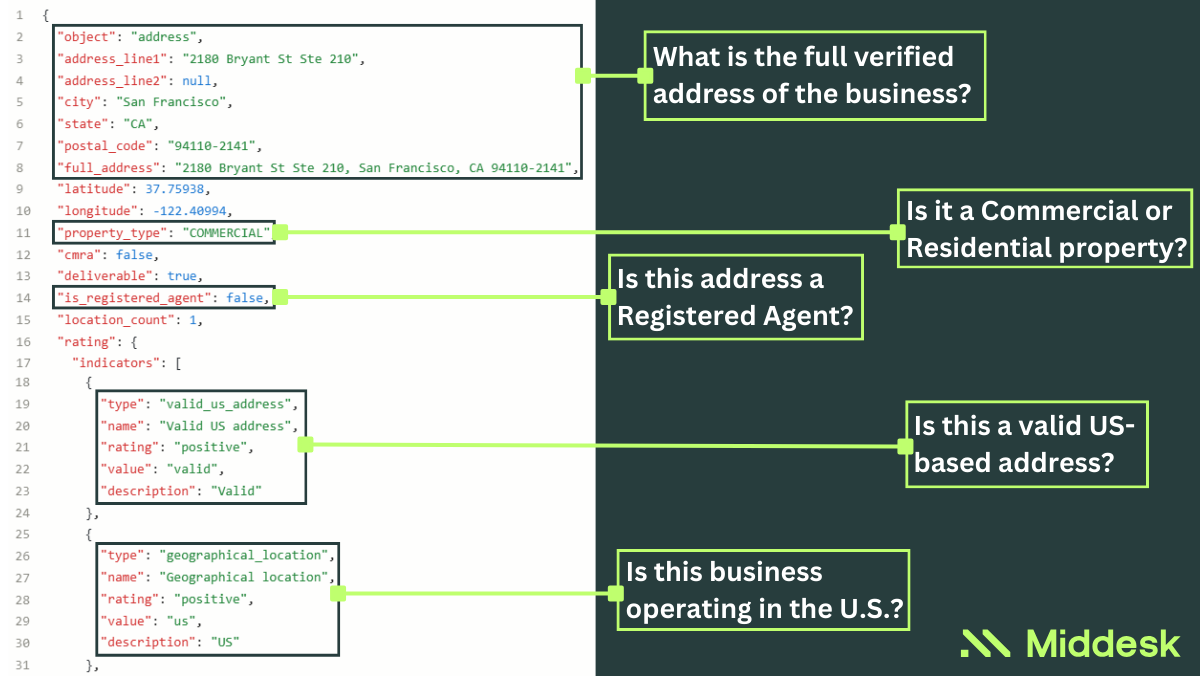
 In an API, you’re usually doing this on a larger scale, so you set up a custom API key within your tool, and then input strings to get the tool to verify information in the Secretary of State database in the background, and then return the results to you. The tool will verify information for you in strings, boolean, timestamps, etc., but will still validate the information you are looking for.
In Middesk’s Secretary of State API, that might look something like this:
What kind of information can you get from a Secretary of State API?
In an SOS API, you can validate any information that’s in the Secretary of State databases. This includes:
- Business name: Legal name, known names, “Doing Business As” names
- Business address: Legal addresses, mailing addresses, business locations
- Business entity: Legal name, doing business as, entity type (LLC, corporation, etc.)
- Business ownership: Who owns the business, officer names, UBOs
- Business status: In good standing with the IRS, formation dates, dissolution status
- Business documents: Articles of Incorporations, formation documents
- Registered Agent: Designated agent name and address
- UCC liens: If they have any liens filed against them
- Bankruptcy status: If they have filed for bankruptcy
Common use cases for a Secretary of State API for business verification
Any company that wants or needs to regularly work with other businesses as clients or partners – and thus has to verify their identities and assess their risks as per KYB regulations – can find having API access to Secretary of State portals useful.
Here are a few industries in which SOS API use is common:
Fintechs
One of the biggest benefits that fintechs offer their customers is onboarding with less friction and greater speed, but this can’t come at the expense of security and regulatory objectives. Getting information quickly through a Secretary of State API helps neobanks and fintechs onboard business clients or partners faster, helping them maintain their agility advantage while still remaining compliant.
Learn how Middesk accelerates business onboarding for fintechs
Traditional banks
In many places in the U.S., businesses have to be registered with the Secretary of State before they can open commercial bank accounts. Banks performing KYB need to be able to rapidly pull up the necessary information and documentation from the SOS office to verify this for each applying business. Using an API helps banks get this information quicker, preventing slowdowns in onboarding that discourage customers from using their bank. This leads to more – and happier – business customers, making this a great addition to a CIP program in banking.
Lenders
Companies and lenders offering corporate loans need to know that they’re dealing with legitimate businesses, and they need an understanding of the degree of risk each business represents to determine how much money to lend, how much interest to charge, and other terms of the agreement.
Accessing Secretary of State records through an API helps lenders quickly verify that a business is properly registered, as well as check other information that may indicate risk.
Insuring businesses is another high-stakes industry where there is little room for error. Insurers must make sure businesses that are seeking coverage are real, operating legally, and not presenting an unacceptable level of risk. Having a Secretary of State API helps insurers get the information they need to verify businesses swiftly and from trusted sources. With the adoption of digital banking and the rise of fintechs, modern APIs will help speed up digital lending for business cases.
Marketplace administration
How does a company that runs a marketplace know a business that wants to sell on its platform is trustworthy? Having Secretary of State business verification at its fingertips through an API can certainly help. This allows marketplace administrators to quickly check an applying business for registration documentation indicating the business is legally allowed to operate. It also allows for checking other information that helps administrators determine that a business won’t present an elevated risk of fraud.
Payment Service Providers (PSPs)
Like marketplace administrators themselves, Payment Service Providers (PSPs) also need to know they aren’t indirectly allowing illegitimate businesses to onboard on their platform, enabling them to commit fraud. Establishing and maintaining trust with users is critical to a PSPs longevity.
With access to SOS data via API, an additional layer of verification and trust between all parties in a transaction is built: merchants, payment providers, customers, and marketplace administrators (if the merchant is hosted on a larger marketplace). It also allows payment providers to enhance their onboarding experience by making it faster, more efficient, and seamless.
5 reasons to use a Secretary of State API for businesses verification
So why use a Secretary of State API to fetch business data, as opposed to doing the process manually or using other sources? There are several advantages to using an SOS API; here are five of them.
1. Get data from official sources
Most U.S. businesses are legally required to register with at least one Secretary of State office before they can begin operations. So going right to a Secretary of State portal to verify a business is the surest way to know if a business is officially registered or not.
Relying on the information submitted directly by customers — even if they submit documents to you — is not sufficient enough for a proper KYB process. In the age of fraud-based AI in business verification, it’s easy for fraudsters to generate fake documents or steal the identity of other businesses. The only way to stop this before onboarding is by verifying information directly against the Secretary of State databases.
2. Search multiple SOS portals at once
Looking up information on SOS portals individually can be a hassle. Each state’s SOS portal is designed a bit differently, so it can take time to get used to the interface. Most portals also require registering for an account and paying fees before conducting searches. An API bypasses much of this extra work by pulling data directly from each state’s SOS portal at the same time.
3. Increase verification speed
When onboarding business clients at scale, manual reviews of every business is not sustainable. Using an SOSAPI to instantly pull business information from the Secretary of State portals helps companies verify businesses faster than if they looked up this information manually.
Ready to skip the manual search? Learn how Middesk helps ENGS Commercial Finance Co. save over 50 hours per month with its SOS API, pulling more than one thousand business identities per month - a process that used to take 5 minutes per application.
4. Minimize the risk of human error
Besides being time-consuming, looking up business information manually increases the risk of human-caused mistakes. A compliance team member may accidentally input or copy information incorrectly, or even not be able to find a piece of critical information altogether. An API, if set up correctly, will be able to find and retrieve the precise information you’re looking for. It may also be able to deal with errors in data input (like typos or alternate spellings).
5. Free up human resources by automating tasks
Because an SOS API can automatically pull business data instantly from multiple SOS portals at once, business verification takes less time, and requires fewer compliance agents to complete tasks manually. Instead, they can focus on investigating critical cases that require a manual review.
Top 4 Secretary of State API solutions for business verification
Individual states can sometimes have APIs for querying business information from their Secretary of State offices (like this one from Iowa). But the U.S. federal government doesn’t have a master API for querying all state SOS offices at once, which is why you need a reliable tool that can get the job done.
Here are some of the top choices:
1. Middesk
 Best for: Adding risk assessment on top of business verification
Providing tools for both verifying and underwriting business customers, Middesk goes beyond fetching the information needed to validate a company from Secretary of State portals. It can also fetch information related to watchlist statuses, digital footprint, industry classification, litigations, bankruptcies, and more. So you can find out not only if a company is representing itself truthfully, but also how risky it is to start a relationship with.
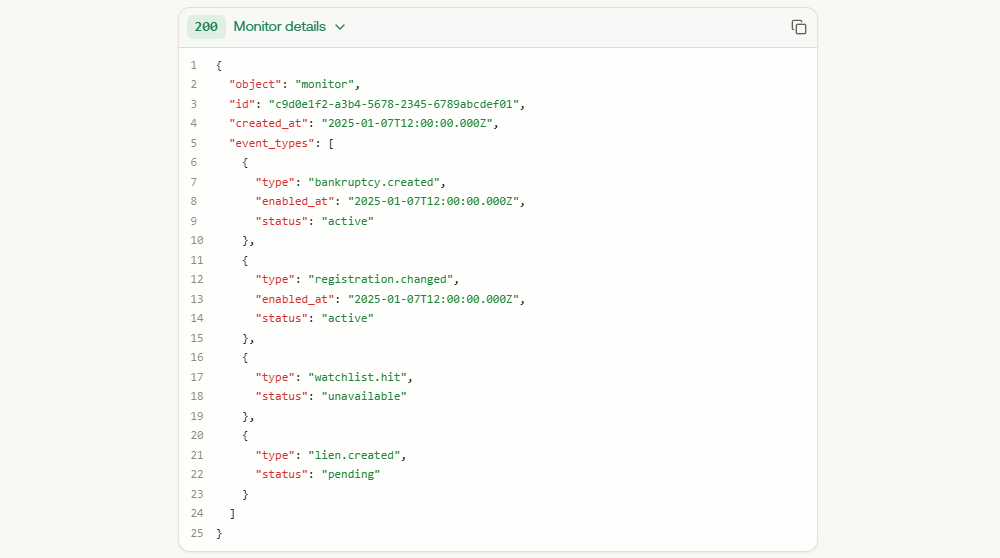
Middesk can also set up Monitoring via the API, so you can conduct ongoing compliance. You can set up a Monitor on the business to see if there’s a change in status when it comes to their business registration, TIN, they filed for bankruptcy, they had a lien filed against them or terminated, or they appeared on a watchlist. All automated, all through the API Monitor.
With Middesk, you can also get this information via an API, a visual dashboard, or both – whatever is most convenient for your organization.
Automate SOS business searches and verify the data you need in seconds. Get a Middesk Demo today!
2. Cobalt Intelligence
Best for: Getting U.S. data quickly and affordably
Cobalt Intelligence is a SOS API provider that offers over 20 attributes of up-to-date business information from Secretary of State offices in all 50 U.S. states. However, it doesn’t appear to cover the District of Columbia, and not all attributes are covered for all states.
3. OpenCorporates
Best for: Finding information on business leaders and owners
OpenCorporates is a worldwide database of information on businesses. It contains data on over 200 million companies and over 300 million corporate officers from over 140 countries and territories. However, its data refresh times can be slow in some places – even in the U.S. – so its data can be stale and incomplete. Its API is also rather expensive to run.
4. DIRO
Best for: Secure, tamper-resistant verification of business information and documents
DIRO provides an API for verifying business documents and information. It draws from over 50,000 data sources across over 195 countries, including Secretary of State offices, financial institutions, utility companies, and other government agencies. It also provides a secure environment in which to validate business documents, so there’s less chance of them being faked or altered.
Middesk’s API covers Secretary of State offices in all 50 states – including DC
Our Business Verification tool is a much faster, accurate, and cost-effective method to check state Secretary of State offices for business information.
In addition to registration details like names, addresses, and TINs, you’ll also get information about a business’s UBOs (via Socure), sanctions lists status, registration documentation, industry classification, web presence, litigations, and more. This lets you go beyond verifying if a business is real and legally registered; it also allows for evaluating how much risk a business presents so you can decide if starting a relationship with that business is a safe idea.
Schedule a demo today to learn more about why our API is an invaluable tool in providing your company direct access to Secretary of State filings, empowering you to verify business faster and more effectively.